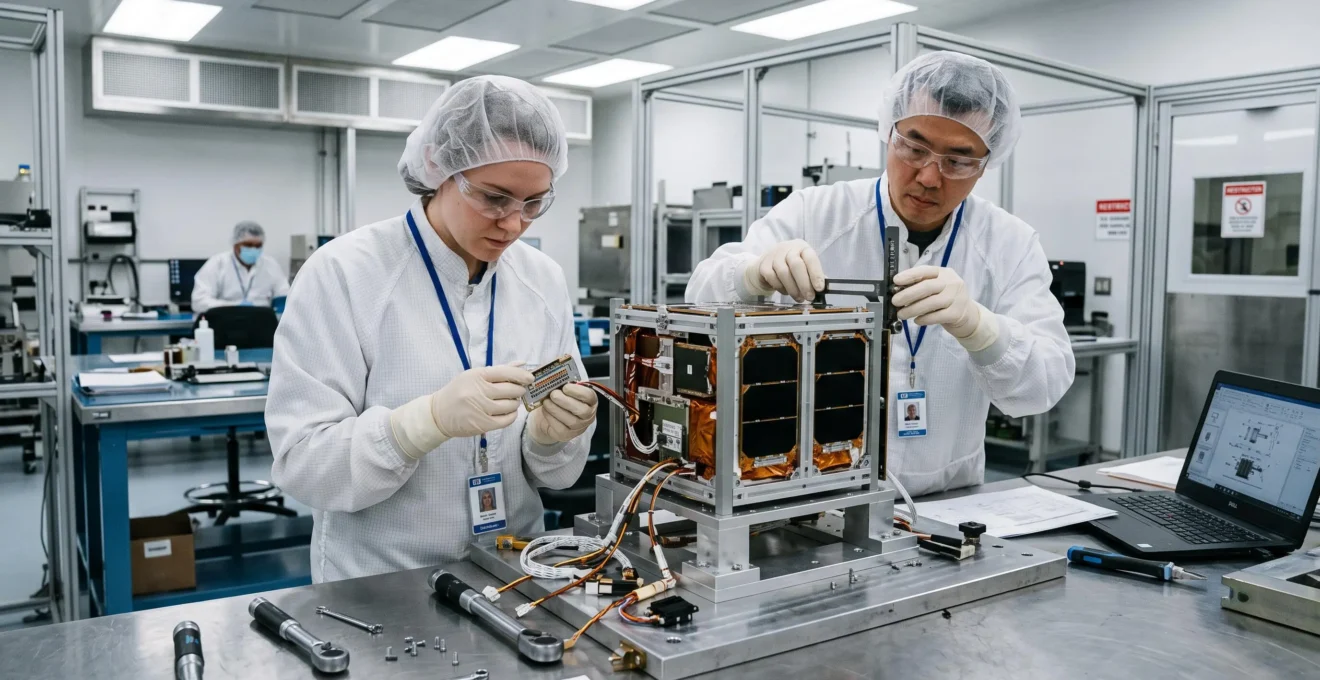
UK and Canadian firms can collaborate across the satellite value chain, from spacecraft components and optical payloads to ground infrastructure, Earth observation analytics and space domain awareness. The commercial opportunity lies in combining capabilities that are difficult, expensive or slow to develop independently.
The two countries already have institutional mechanisms supporting cooperation. Their space agencies strengthened their bilateral framework in 2024, while collaborative initiatives such as the Redwing satellite mission demonstrate how organisations can divide technical responsibilities across borders. These precedents provide useful models, although they do not guarantee access to funding or future procurement contracts.
For space technology suppliers and investors, the central decision is not simply whether to enter the other market. It is where collaboration creates measurable technical or commercial value, which partner can deliver that value, and how responsibilities, intellectual property and regulatory obligations should be allocated. A well-designed relationship can open opportunities beyond its initial mission without requiring either company to surrender control of its core technology.
UK-Canada satellite cooperation: essential decisions
- Target complementary capabilities. Small-satellite systems, sensing payloads, robotics, northern communications and data processing offer potential collaboration opportunities.
- Qualify partners before transferring technology. Flight heritage, export controls, component traceability and intellectual property boundaries matter as much as technical capability.
- Match the partnership structure to the commercial objective. Start with clearly scoped projects and consider deeper alliances when repeat business, shared development and mutual investment justify them.
- Why Are Satellite Systems a Strong Area for UK-Canada Technology Cooperation?
- How Can Space Companies Find the Right UK or Canadian Satellite Partner?
- Hardware, Payload or Data Services: Which Satellite Opportunity Fits Your Business?
- The Integration Risks That Can Disrupt a Cross-Border Satellite Project
- When Should a Satellite Collaboration Become a Strategic Partnership?
- How Can Aerospace Companies Assess a Cross-Border Component Supplier?
- The Capability Overlap That Can Create Conflict in Cross-Border Partnerships
- How Can Cross-Border Collaboration Support Faster Innovation?
Why Are Satellite Systems a Strong Area for UK-Canada Technology Cooperation?
Satellite systems offer a strong basis for UK-Canada cooperation because the two countries have established institutional relationships, complementary industrial capabilities and experience developing shared space technologies. British expertise in small satellites and instrumentation can combine with Canadian capabilities in space robotics, sensing and northern communications. The strongest opportunities emerge when each partner contributes a distinctive capability.
The institutional foundation is significant. In April 2024, the UK Space Agency and Canadian Space Agency signed an enhanced memorandum of understanding, building on an initial agreement established in 2021. According to the UK Space Agency announcement on enhanced UK–Canada space cooperation, the framework supports exchanges of information, technology and personnel, alongside coordination on space policy, standards and regulation.
This arrangement can make institutional contacts and joint research planning easier. It is not, however, a substitute for individual commercial agreements, export authorisations or programme-specific procurement rules.
The value of cooperation becomes clearer when capabilities are considered together. A British supplier specialising in compact spacecraft instrumentation could work with a Canadian organisation experienced in remote sensing applications or northern communications infrastructure. Equally, Canadian sensor or robotics expertise could complement a British spacecraft platform or mission integration service.
These are potential combinations rather than exclusive national specialisations. Both countries have companies operating across several segments of the space industry. Partner selection should therefore assess actual company capabilities instead of relying on national stereotypes.
There are also concrete precedents. The proposed Canadian CASTOR astronomy mission includes early British work on imaging technology, electronics and scientific data processing. Separately, the Redwing space domain awareness mission demonstrates planned cooperation involving British instrumentation and Canadian satellite development.
Real collaboration: the Redwing satellite mission
The Redwing programme, announced in October 2024, combines Canadian space domain awareness objectives with a British experimental short-wave infrared camera intended for the LISSA nanosatellite. The University of Manitoba was identified as LISSA’s builder, while Magellan Aerospace was assigned responsibilities covering spacecraft development and operations.
The mission illustrates how satellite manufacturing, payload qualification and data-processing responsibilities can be distributed internationally. The announcement described a planned mission, not a completed orbital demonstration.
A successful project may also build the technical credibility needed to compete for subsequent commercial and institutional opportunities. Demonstrated interoperability, documented qualification and established working relationships can reduce uncertainty for prospective customers. Nevertheless, participation in one programme does not confer automatic eligibility for another, particularly where defence or national-security restrictions apply.
That distinction provides the starting point for finding partners whose contribution is technically indispensable and commercially sustainable.
How Can Space Companies Find the Right UK or Canadian Satellite Partner?
Space companies should identify potential partners through recognised industry networks, institutional programmes and technical supply chains, then assess them against mission-specific requirements. The best partner is not necessarily the largest or most visible company. It is the organisation with compatible technical interfaces, credible delivery experience, appropriate regulatory permissions and a commercial reason to cooperate.
On the British side, the UK Space Agency provides visibility into funded projects, international initiatives and participating organisations. UKspace, the industry association, offers another route to understanding the national ecosystem and identifying companies active in relevant segments.
In Canada, Canadian Space Agency programmes, industry showcases and published project information can help companies identify specialists in payloads, robotics, communications, remote sensing and spacecraft systems. Supplier information should be verified directly, because a public programme listing is not necessarily a current or comprehensive supplier directory.
These discovery channels serve different purposes. Institutional programmes help reveal organisations with relevant research experience. Industry associations support commercial networking. Mission announcements can expose the relationships between prime contractors, subsystem suppliers, universities and operators.
The next stage is qualification rather than general networking. A practical evaluation should cover the prospective partner’s technical responsibilities, contractual constraints and ability to support a mission throughout its lifecycle.
Five actions to qualify a UK or Canadian satellite partner
- Define the mission requirement: produce a one-page capability and interface specification identifying what the partner must deliver.
- Compile a targeted shortlist: prepare a partner matrix recording relevant technology, mission references, facilities and potential conflicts.
- Check regulatory exposure: create a preliminary export-control and security screening record covering technology, destinations and intended end uses.
- Verify delivery evidence: request a qualification dossier containing relevant test reports, flight heritage, traceability arrangements and supplier references.
- Set information-sharing boundaries: establish an appropriate confidentiality agreement and an approved technical disclosure schedule before exchanging sensitive design information.
A frequent complication is that prospective partners may also compete for the same public contracts. A supplier providing payload integration support for one mission could be bidding independently on the next. Consequently, an initial confidentiality agreement should distinguish information required for feasibility assessment from proprietary knowledge that does not need to be transferred.
Government programme involvement deserves separate scrutiny. A company may have experience supporting a government mission without possessing permission to reuse restricted technology, disclose programme information or involve a foreign subcontractor in another contract.
Once a credible partner has been identified, the next commercial question is which part of the satellite value chain provides the most suitable entry point.
Hardware, Payload or Data Services: Which Satellite Opportunity Fits Your Business?
The best satellite opportunity depends on a company’s capital resources, technical differentiation and tolerance for regulatory and commercial risk. Hardware manufacturing generally requires substantial qualification investment, payload development depends on access to compatible platforms, and data services can offer a less capital-intensive route. Hybrid models can capture greater value but introduce additional operational complexity.
These entry routes have different economic structures. Hardware suppliers invest in components, manufacturing processes and acceptance testing before significant revenue is secured. Payload specialists must demonstrate compatibility with satellite platforms and mission requirements. Data service providers concentrate more heavily on software, analytics, distribution rights and customer acquisition.
| Decision criterion | Hardware | Payloads | Data services |
|---|---|---|---|
| Typical offering | Components, subsystems and spacecraft equipment | Sensors, instruments and mission-specific equipment | Earth observation analytics, communications applications and information products |
| Capital requirements | Often high due to manufacturing and qualification | Variable; specialised development and testing may be expensive | Potentially lower physical infrastructure investment, depending on data acquisition and processing needs |
| Principal dependency | Qualified supply chains and manufacturing capacity | Spacecraft integrators, interfaces and flight opportunities | Data access, licences, infrastructure and customers |
| Major commercial risk | Long qualification cycles and concentrated customers | Integration delays and programme cancellation | Renewal of data rights, service continuity and competitive differentiation |
| Potential advantage | Long-term component supply relationships | High-value mission-specific intellectual property | Recurring revenue and direct customer relationships |
A British SME with established small-satellite electronics capabilities may find payload or subsystem integration an attractive route into Canadian programmes. A Canadian company working in remote sensing or northern communications may find opportunities in providing data products, application expertise or operational services to British customers.
These are commercially plausible pathways, not guaranteed advantages based on company nationality. Actual market entry depends on customer demand, ownership of essential technology and compliance with programme rules.
Data services can create negotiating leverage when a supplier owns distinctive algorithms, customer relationships or processing expertise. A spacecraft manufacturer may need these capabilities to convert raw satellite observations into commercially useful products.
However, the provider’s position can weaken if essential imagery, communications capacity or distribution rights depend on licences that must be renewed. Long-term profitability therefore depends on understanding data provenance, contractual restrictions, service-level commitments and applicable data governance rules.
A hybrid business model combines proprietary hardware with subscription-based services. For example, a company might develop a specialised sensor and commercialise the resulting observations through recurring analytics contracts. This can strengthen product differentiation but creates potential channel conflict if satellite manufacturers or existing distributors also expect to control customer access.
Hybrid arrangements work best when the agreement clearly separates component supply, ownership of derived information, distribution rights and customer responsibilities.
Whichever entry route is selected, the expected returns must be evaluated against the costs and risks of integrating technology across two regulatory and engineering environments.
The Integration Risks That Can Disrupt a Cross-Border Satellite Project
Cross-border satellite projects are most vulnerable when export restrictions, qualification requirements and technical interfaces are addressed too late. Even individually proven components may fail to integrate smoothly if partners use incompatible test assumptions or data formats. Intellectual property exposure, financing schedules and liability allocation can create further delays that are difficult to resolve once manufacturing begins.
Export controls are an early priority. UK and Canadian firms must determine whether their equipment, software, technical information or assistance is controlled under applicable national rules. Third-country-origin technology may introduce additional restrictions, depending on its classification and licensing conditions.
Permission to trade ordinary commercial goods between the UK and Canada should not be confused with authorisation to transfer controlled space technology.
The broader trade framework includes the UK-Canada Trade Continuity Agreement, which entered into force in April 2021. Since September 2026, qualifying UK-Canada trade may also use the Comprehensive and Progressive Agreement for Trans-Pacific Partnership. The UK government guidance on trading with Canada explains relevant trade arrangements, including origin requirements and conformity-assessment provisions.
Neither framework eliminates space-specific export controls, security restrictions or the need for suitable technical qualification.
Qualification differences also deserve attention. A British supplier may work with European Cooperation for Space Standardization requirements, while a Canadian programme may specify a different combination of customer requirements, qualification practices and applicable standards.
The practical solution is not to presume that one country’s standards are universally stricter. Partners should prepare a requirements crosswalk showing which tests, analyses and documentary evidence satisfy the actual mission specification.
Budget timing introduces another difficulty. Government agencies, universities and commercial primes may approve expenditure through different processes. A supplier can complete its design review while its counterpart is still awaiting approval for a critical manufacturing phase. Contracts should therefore address funding dependencies, decision deadlines and the consequences of schedule changes.
Technical interfaces are an especially important source of hidden risk. Mechanical compatibility alone is insufficient. Power budgets, telemetry definitions, thermal behaviour, timing references and calibration methods must also be aligned.
Partners should agree on interface control documents before detailed integration. Early test planning should include shared reference datasets, calibration procedures, acceptance thresholds and responsibility for investigating anomalies.
Protecting intellectual property requires similarly deliberate design. A documented interface can expose only the information needed for interoperability, while a black-box approach can preserve proprietary internal algorithms or circuitry. Such separation must still permit adequate verification, fault analysis and safety assurance.
Finally, responsibility for failure in orbit should be addressed contractually. Warranty obligations, insurance, remedies, liability limitations and allocation of investigation costs depend on the parties’ roles, applicable law and programme structure. International space-law obligations do not automatically settle contractual liability between suppliers.
When partners repeatedly manage these challenges successfully, the case for a more permanent commercial relationship becomes stronger.
When Should a Satellite Collaboration Become a Strategic Partnership?
A satellite collaboration should become a strategic partnership when the companies have evidence of recurring demand, a shared technology roadmap and mutual dependence that extends beyond one mission. Formalisation is most valuable when coordinated investment or protected access to capabilities creates measurable benefits. It is premature when commercial demand, technical compatibility or responsibilities remain uncertain.
Three indicators are particularly useful. First, the organisations have opportunities to work together on multiple programmes rather than one isolated contract. Second, their future product development plans require coordinated technical decisions. Third, replacing either partner would introduce substantial qualification costs, delays or loss of distinctive capabilities.
Even when these conditions are present, the appropriate structure is not necessarily a joint venture.
| Structure | Main benefit | Main consideration |
|---|---|---|
| Contractual alliance | Defined cooperation without shared corporate ownership | Requires clear scope, governance and exit rights |
| Joint venture | Dedicated organisation for shared investment or products | Creates governance, financing and control obligations |
| Equity participation | Potential long-term financial and strategic alignment | May raise investment screening and control concerns |
Intellectual property ownership should strongly influence the choice. If both companies need to retain independent exploitation rights over their original technologies, a contractual alliance with defined licences may be more suitable than transferring assets into a shared entity.
Government procurement requirements can also matter. A jointly owned business should not be assumed to qualify automatically for contracts reserved for particular national entities or subject to security restrictions. Ownership, control and programme-specific eligibility must be assessed separately.
The timing of formalisation creates competing risks. An exclusive agreement signed too early can restrict access to alternative customers or suppliers. Waiting indefinitely may allow a competing organisation to secure an important commercial relationship.
A practical alternative is staged commitment: begin with a technical feasibility phase, progress to a funded demonstration, then consider longer-term exclusivity or investment once predefined technical and commercial milestones are achieved.
Formal partnerships can strengthen an investment proposition by demonstrating customer alignment and reducing some development uncertainty. They may also support joint research applications. However, grant eligibility does not generally require equity integration, and foreign investment reviews may become relevant if control or ownership changes.
Before increasing dependence on a partner, companies should apply equally rigorous scrutiny to the suppliers and components on which their shared programmes rely.
How Can Aerospace Companies Assess a Cross-Border Component Supplier?
Aerospace companies should assess cross-border component suppliers through three levels of due diligence: compliance with applicable quality and qualification requirements, traceability of components and manufacturing processes, and resilience of the supplier’s own supply chain. Price and delivery lead time remain relevant, but they cannot compensate for an inability to demonstrate mission suitability or sustain production.
The first level establishes whether a supplier can meet the purchasing programme’s technical requirements. This may involve evidence aligned with applicable ESA or ECSS requirements, customer-specific quality provisions, or relevant Canadian programme specifications. Certifications and quality management systems should be assessed for their actual scope, not treated as universal proof of flight readiness.
The second level examines traceability. Buyers should be able to establish the origin of critical materials and parts, identify manufacturing lots, review non-conformance records and understand how changes are controlled.
The third level concerns operational resilience. A supplier may have excellent engineering capabilities while depending on a vulnerable subcontractor for a specialised coating, electronic component or manufacturing process. Due diligence should therefore extend to critical lower-tier dependencies where the supplier can lawfully provide the necessary information.
These checks become more important when replacement is difficult. A component already qualified for a spacecraft design cannot always be substituted with a commercially equivalent product. Requalification may require additional engineering, testing and programme approval, potentially outweighing the savings from changing suppliers.
The evaluation should also distinguish standard catalogue components from custom-designed equipment. For standard components, purchasing terms may concentrate on specification, traceability, change notification and continuity of supply. For build-to-print or custom equipment, the contract must additionally clarify design ownership, manufacturing files, tooling, modification rights and access to alternative production sources.
Continuity protections can include agreed critical-part stocks, obsolescence notification, audit rights and arrangements for maintaining documentation. The appropriate mechanism depends on the component’s criticality, availability and the supplier’s financial position.
Cross-border enforcement adds another dimension. Contracts should identify governing law, dispute resolution, access to records and practical remedies. A contractual right is less useful if exercising it would be too slow to protect the mission schedule.
Supplier diligence also helps reveal whether the parties are truly complementary or whether overlapping capabilities could create competition inside the partnership.
The Capability Overlap That Can Create Conflict in Cross-Border Partnerships
Capability overlap creates conflict when partners can perform the same activities and begin competing for future work packages, customers or intellectual property. Overlap is not inherently harmful: shared expertise can improve verification and resilience. Problems arise when the agreement does not distinguish legitimate independent competition from responsibilities and information specifically reserved for the joint project.
Consider two companies capable of integrating small satellites. They may cooperate successfully on an initial mission because one provides the spacecraft platform while the other supplies a specialised subsystem. On a later programme, however, both may be qualified to lead integration.
The next contract then introduces a commercial question: which organisation should receive the higher-value role? Without a previously agreed process, the disagreement can affect engineering cooperation, pricing and willingness to share technical information.
A useful diagnostic maps each company’s capabilities against the entire satellite value chain.
| Value-chain activity | Assessment question | Potential conflict |
|---|---|---|
| Mission design | Can both companies define the spacecraft architecture? | Control of system requirements |
| Manufacturing | Can either company produce the same component? | Allocation of production contracts |
| Integration | Can both act as prime integrator? | Competition for programme leadership |
| Operations | Can either operate the satellite or ground segment? | Control of recurring service revenue |
| Data commercialisation | Do both sell similar information products? | Customer ownership and distribution rights |
This assessment should separate complementary strengths, shared competencies and direct competitive exposure. The aim is not to eliminate overlap completely, but to decide where cooperation ends and independent commercial activity begins.
Mutual non-compete provisions may appear attractive because they reduce the possibility of direct competition. Yet broad restrictions can prevent both parties from pursuing unrelated customers or developing technologies outside the collaboration. Such provisions require careful commercial and legal scrutiny, including applicable competition law.
More targeted arrangements may be preferable: project-specific exclusivity, defined customer or application boundaries, restrictions on using confidential information, and procedures for resolving competing bids.
Another subtle risk is unplanned knowledge transfer. Over time, a company may acquire enough practical insight into its partner’s methods to reproduce capabilities internally. Not all learning is prohibited, but the agreement should distinguish independently developed expertise from protected technical information.
Regular capability reviews can identify changing competitive positions before they become disputes. They also provide an opportunity to adjust workshare, licensing arrangements and information-access rules as the programme develops.
With boundaries established, the partnership can concentrate on the area where international cooperation has the greatest potential impact: developing and qualifying new technologies more efficiently.
Key takeaways before launching a joint innovation programme
- Identify which development or qualification activities genuinely benefit from shared facilities, complementary expertise or combined investment.
- Agree on ownership, licensing and commercial exploitation of new intellectual property before beginning joint technical work.
- Compare the expected development savings with the additional coordination, regulatory and contractual costs of international cooperation.
How Can Cross-Border Collaboration Support Faster Innovation?
Cross-border collaboration can accelerate satellite innovation when partners contribute complementary engineering expertise, share development costs and coordinate access to testing or qualification facilities. The benefit is strongest when cooperation removes a genuine technical bottleneck. International coordination can instead slow development if governance, approvals and intellectual property negotiations consume more resources than the collaboration saves.
Space technology development often requires specialised facilities that individual companies cannot economically maintain. Environmental testing, instrument calibration, electromagnetic compatibility assessment and spacecraft integration may depend on equipment and expertise available through research institutions or industrial partners.
A bilateral project can improve access to relevant capabilities when appropriate facilities, contracts and permissions are available. This is particularly valuable if one organisation already possesses the technical infrastructure needed to qualify the other’s component or payload.
Partners can also share non-recurring engineering expenditure. Instead of independently developing duplicated subsystems, they may allocate work according to existing competence and combine the resulting technology within a common architecture.
Different engineering approaches can provide an additional benefit. Independent design reviews, alternative testing methods and exposure to different operational environments may reveal weaknesses that a single team would otherwise overlook. These advantages depend on effective technical governance rather than international participation alone.
Funding provides a concrete opportunity. The UK Space Agency International Bilateral Fund Call 3 funding conditions explicitly encourage partnerships with Canadian organisations, alongside several other countries.
Up to £1.5 million
Maximum UK Space Agency grant contribution per project under International Bilateral Fund Call 3. Funding is competitive, eligibility-dependent and not guaranteed to participating organisations.
UK Space Agency, International Bilateral Fund Call 3, 2026.
The published call opened on 24 August 2026 and has an application deadline of 4 November 2026 at 3:00 pm. Projects may run for up to 18 months and must begin on 1 April 2027. Applications must be led by a UK organisation and include an international partner and matched contributions, subject to the published conditions.
The required collaboration arrangements must address project delivery and exploitation of results, including intellectual property. Canadian participation is encouraged, but the programme is not exclusively a UK-Canada funding mechanism.
For companies seeking support from more than one funding source, eligible costs, subsidy conditions and reporting requirements must be reviewed separately. An activity funded under one programme cannot simply be assumed eligible for duplicate reimbursement under another.
Funding structures should reflect the work actually undertaken by each participant, with clear financial contributions and documented responsibility for deliverables.
Intellectual property governance is equally important. Joint ownership may be appropriate for inseparable inventions, but it can complicate commercial licensing if exploitation rights are unclear. Cross-licensing or territory-specific commercial rights may offer better flexibility for companies with distinct markets.
The collaboration agreement should address background intellectual property, newly generated results, publication rights, sublicensing and what happens if a partner exits. These provisions determine whether successful research can move into commercial production without another extended negotiation.
Finally, innovation speed must be assessed against coordination costs. A short development task with few technical dependencies may be completed more efficiently by one supplier. A larger programme involving specialised testing, complex payload integration or shared mission infrastructure may justify the additional governance burden.
The practical next step is to prepare a focused joint feasibility brief covering technical contributions, interfaces, qualification resources, intellectual property rights, commercial objectives and regulatory constraints. This provides a defensible basis for deciding whether to pursue a funded demonstration, a supply agreement or a longer-term strategic relationship.
Can a Canadian satellite company apply directly for UK bilateral space funding?
Under UK Space Agency International Bilateral Fund Call 3, a UK organisation must lead the application. Canadian companies can participate as international partners where the project satisfies the published requirements. Eligibility, matched contributions and contractual arrangements must be checked for each funding opportunity.
Does the UK-Canada trade agreement remove export controls on satellite components?
No. Trade agreements can provide rules for eligible goods, services and investment, but they do not automatically authorise controlled technology transfers. Satellite suppliers must assess applicable export classifications, licensing requirements, national-security restrictions and relevant third-country controls separately.
Can satellite companies collaborate without sharing ownership of their intellectual property?
Yes. A contractual collaboration can preserve each participant’s existing intellectual property while granting limited rights needed for development, testing or commercial exploitation. The agreement should distinguish background technology from project-generated results and specify the permissions required for each party’s responsibilities.
Does successful flight heritage automatically qualify a component for another satellite mission?
No. Flight heritage provides useful evidence, but qualification depends on the new mission’s environment, design configuration, operating conditions and acceptance requirements. Changes in materials, manufacturing processes or interfaces may require additional verification or testing.
What should companies establish before starting a bilateral satellite feasibility project?
They should define a shared technical objective, identify each organisation’s deliverables, establish preliminary interface requirements, screen regulatory constraints and agree on confidentiality and intellectual property boundaries. A preliminary cost, schedule and risk assessment then helps determine whether the project warrants a formal development agreement.