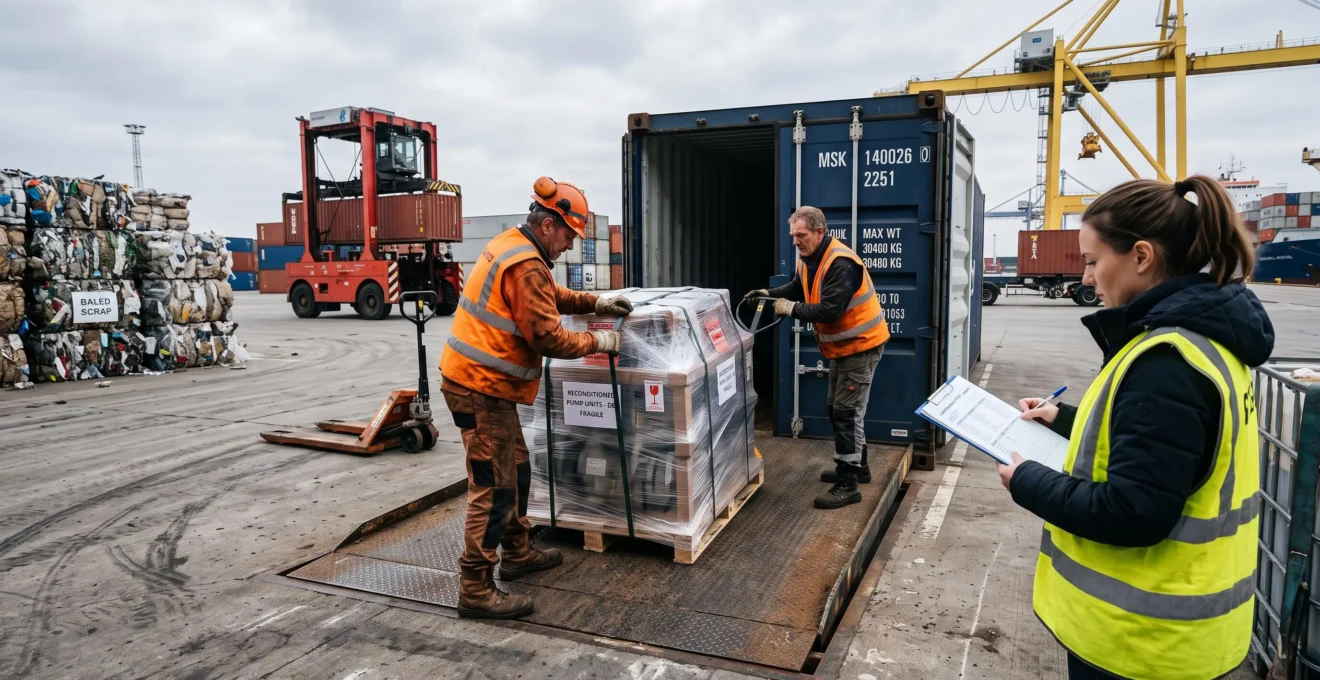
Circular economy models create commercial opportunities between the United Kingdom and Canada by turning discarded materials, returned products and underused equipment into sources of business value. Rather than relying exclusively on newly manufactured goods, companies can develop repair services, refurbishment partnerships, recycled-material supply agreements and resource-sharing arrangements across both markets.
The opportunity is not simply to export waste or move reusable products across the Atlantic. Successful circular trade depends on matching recovered materials with customers who can use them profitably, while controlling transport costs, product quality and regulatory obligations.
UK manufacturers may find opportunities to supply refurbishment expertise or specialist components, while Canadian businesses may offer processing capacity, industrial materials or access to customers seeking alternative inputs. These are potential commercial configurations, not guaranteed advantages for every sector.
Understanding where value is retained, where it is lost and when local processing makes more sense than international shipping is essential before committing capital to a circular supply chain.
Circular economy opportunities: the essentials
- Reuse, repair and recycling can improve material productivity and reduce dependence on virgin inputs, provided recovery costs remain commercially viable.
- UK-Canada opportunities are strongest when reliable material flows, identifiable buyers and compatible technical specifications support repeat transactions.
- Cross-border expansion should follow successful domestic validation, careful regulatory checks and realistic logistics and financial stress tests.
- Why Can Circular Business Models Improve Both Resource Efficiency and Competitiveness?
- How Can Companies Find Profitable Circular Economy Opportunities in Their Supply Chain?
- Reuse, Repair or Recycling: Which Circular Model Fits Your Product?
- The Commercial Risks That Can Make a Circular Economy Project Unsustainable
- When Should a Circular Business Model Expand Between the UK and Canada?
- How Can UK and Canadian Firms Build a More Integrated Supply Chain?
- The Project Risks That Can Undermine Cross-Border Renewable Energy Expansion
- How Can Shared Supply Chains Strengthen UK-Canada Business Relationships?
Why Can Circular Business Models Improve Both Resource Efficiency and Competitiveness?
Circular business models can improve competitiveness by extracting additional economic value from materials and products already in circulation. Reuse, repair and refurbishment may reduce purchases of virgin inputs, create service revenue and limit exposure to certain supply disruptions. These advantages depend on recovering usable value at a cost below the commercial benefit generated.
Resource efficiency and circular efficiency are related but distinct. Resource efficiency means producing an equivalent output with fewer inputs, such as reducing manufacturing scrap. Circular efficiency means retaining or recovering value from existing assets, such as rebuilding industrial equipment for another operating cycle.
The first approach often requires process improvements. The second may require reverse logistics, inspection, repair expertise, product traceability and new commercial arrangements.
Both can strengthen purchasing resilience, but neither eliminates exposure to market prices. A company using recovered metals may become less dependent on newly extracted material while remaining exposed to collection costs, recycled-material prices and inconsistent feedstock quality.
Public policy is also changing the commercial context. The UK joint policy statement on packaging extended producer responsibility identifies waste prevention, packaging reuse and improvements in recycling as policy objectives across the four UK nations. Actual obligations depend on the applicable regulations and business activities.
In Canada, Canada’s 2025-26 federal plan for a circular plastics economy documents an initiative running from April 2022 to March 2027 in support of the federal zero-plastic-waste goal for 2030. This is a plastics-focused policy initiative, not a universal regulatory requirement for all materials.
These frameworks can influence purchasing criteria and investment decisions. They do not, by themselves, establish that circular products are cheaper or more profitable.
A preliminary financial test should compare the recovered selling value and avoided purchasing or disposal costs against collection, sorting, processing, transport, quality assurance and administration. The relevant measure is incremental contribution after these costs, not the headline resale value.
When that comparison supports a positive economic case, the next challenge is identifying the most promising material flows within the supply chain.
How Can Companies Find Profitable Circular Economy Opportunities in Their Supply Chain?
Companies can identify profitable circular opportunities by mapping material losses, estimating recoverable value and prioritising streams whose commercial return exceeds their recovery costs. Existing purchasing, production, inventory and returns data provide a practical starting point. The strongest opportunities are not necessarily the largest waste streams, but those combining usable quality, dependable demand and manageable logistics.
A three-stage mapping exercise helps distinguish promising projects from activities that merely divert material from disposal.
- Identify lost value. Record production offcuts, rejected components, returned products, unused stock and discarded packaging. Note volumes, material types, condition and current treatment.
- Estimate recovery economics. Determine plausible resale or reuse value, then assess inspection, sorting, storage, processing and transportation costs.
- Rank commercial opportunities. Prioritise flows with identified customers, consistent specifications and a positive expected contribution after recovery costs.
Existing datasets require interpretation. Waste tonnage may conceal high-value fractions, while a high product return rate may reflect seasonal sales rather than a reliable refurbishment opportunity. Purchasing records may also understate the value of avoided downtime or replacement lead times.
Internal circular opportunities include reusing packaging on site, repairing equipment or reducing avoidable scrap. Inter-company opportunities include supplying a manufacturer’s by-products as usable inputs for another business, an arrangement often described as industrial symbiosis.
Industrial symbiosis can unlock revenue where internal reuse is impractical. However, profitability depends on the receiving company’s technical requirements and willingness to pay. The need for an external partner also adds coordination, contractual and continuity risks.
Scale is not always decisive. A small stream of specialist industrial components may support profitable refurbishment if each unit retains substantial value. Conversely, large volumes of low-value material may be uneconomic when transportation and separation costs are high.
Five actions to validate a circular supply chain opportunity
- Extract purchasing, scrap and returns records for a defined operating period; produce a material-flow inventory with volumes and categories.
- Inspect representative material samples; produce a condition and technical-quality assessment.
- Request indicative recovery, processing and logistics quotations; produce a cost-per-unit comparison.
- Identify potential internal users or external buyers; produce a shortlist documenting required specifications and evidence of demand.
- Compare conservative revenue and savings estimates with full recovery costs; produce a pilot decision sheet with a break-even threshold.
Once a commercially attractive flow has been identified, the next decision is whether it should be reused, repaired or recycled.
Reuse, Repair or Recycling: Which Circular Model Fits Your Product?
The appropriate circular model depends on the product’s remaining useful life, restoration costs, logistics requirements and destination-market regulations. Reuse generally preserves more of a product’s existing functionality, repair restores lost performance, and recycling recovers material value. For UK-Canada trade, the most commercially attractive option is the one retaining sufficient value after transport, processing and compliance costs.
A practical decision framework compares four variables before selecting a model.
| Decision criterion | Reuse or repair | Recycling |
|---|---|---|
| Remaining product life | Best suited to products with useful operating life or recoverable functionality. | Relevant when functional recovery is impractical or uneconomic. |
| Restoration cost | Requires inspection, replacement parts, labour and testing. | Requires material separation, processing and quality control. |
| Logistics distance | Can justify longer journeys when retained unit value is sufficiently high. | Often favours consolidated transport or processing near the material source. |
| Regulatory requirements | Product safety, modifications, documentation and market access must be assessed. | Material specifications, waste classification and shipment requirements must be assessed. |
Consider an industrial pump with substantial remaining mechanical value. Refurbishment may preserve expensive components and create a commercially viable second life. The same pump, if severely damaged or economically irreparable, may be better suited to material recovery.
The conventional preference for reuse over recycling should therefore be evaluated alongside the environmental and financial effects of transatlantic transport. Shipping heavy, low-value equipment for repair can undermine both objectives when comparable processing is available locally.
Regulatory status matters particularly when refurbished products enter another market. The UK government guidance on placing UKCA or CE marked products on the market explains the applicable product conformity framework for Great Britain. Requirements depend on the product category, and CE marking remains recognised for relevant products under specified conditions.
A repair does not automatically preserve or invalidate previous conformity status. The nature of any modification, the product’s intended use and the applicable regulations must be examined. Northern Ireland and Canada require separate market-specific consideration.
Customer structure also changes the decision. An industrial supplier serving a small number of contracted buyers may organise planned equipment returns. A consumer electronics retailer serving dispersed customers faces more complex collection and grading requirements. Reusable packaging may work well within a controlled business-to-business distribution loop but be harder to retrieve from individual consumers.
The preferred model still needs protection against commercial risks that can weaken margins and undermine customer confidence.
The Commercial Risks That Can Make a Circular Economy Project Unsustainable
A circular economy project becomes commercially unsustainable when recovery costs, unreliable material quality, weak demand or contractual dependencies overwhelm the value it creates. Businesses must assess these risks before investing in collection networks or processing facilities. A circular model needs resilient unit economics, dependable partners and clear product responsibilities rather than relying solely on its environmental proposition.
Partner concentration is one significant risk. A business that depends on a single collection operator or refurbishment specialist may face operational disruption if that partner increases prices, loses capacity or exits the market.
Contracts can reduce exposure through minimum service levels, agreed material specifications, performance reviews, data-access rights and workable termination provisions. Where feasible, qualifying a second supplier offers additional protection without requiring equal volumes to be allocated to both partners.
Secondary-material price volatility is another concern. If virgin-material prices fall, buyers may become less willing to pay a premium for recovered alternatives. A recovery process that appears profitable under favourable market conditions may then produce insufficient contribution to cover its costs.
A sensitivity analysis should therefore test lower recovered-material selling prices, reduced processing yields, higher energy costs, increased transportation charges and temporary buyer interruptions.
Illustrative scenario: testing recycling economics
Consider a hypothetical business recovering specialist manufacturing offcuts. The project is profitable when its verified selling price exceeds the combined sorting, processing, storage, transportation and administration costs.
Management then tests a scenario in which the recovered material’s selling price declines while processing costs remain unchanged. If the resulting margin becomes negative, the company needs a commercial safeguard, a lower-cost recovery process or a different outlet before expanding capacity.
This is a decision-making illustration, not a documented UK or Canadian company case.
Quality and warranty risks require equal attention. A refurbished product must meet agreed functionality, safety and performance expectations. Inspection records, documented tests, transparent condition descriptions and suitable contractual warranties help manage disputes.
Different regulatory definitions across the UK and Canada add another layer of uncertainty. Material classified or reported as recycled in one jurisdiction may not qualify for an equivalent claim or treatment in another. Companies should verify definitions and reporting methodologies before using common performance figures in commercial or sustainability disclosures.
When these exposures can be controlled, international expansion becomes a possible next step rather than an additional source of unmanaged risk.
When Should a Circular Business Model Expand Between the UK and Canada?
A circular business model should expand between the UK and Canada when domestic operations demonstrate repeatable profitability, credible demand exists in the destination market and logistics can preserve sufficient economic value. Internationalisation should follow evidence of reliable recovery yields, product quality and buyer acceptance. Trade preferences may improve access, but they cannot compensate for an unproven commercial model.
Three signals support an expansion decision: a domestic market unable to absorb all commercially recoverable output, confirmed interest from customers in the other country, and a tested fulfilment process capable of meeting price and delivery requirements.
These signals should be assessed together. Excess recovered stock without a committed overseas buyer is not sufficient evidence of an export opportunity. Equally, buyer interest is not decisive if customs procedures, transport or product certification make delivery uneconomic.
The UK-Canada Trade Continuity Agreement has applied since April 2021. The CPTPP has also been available for trade between the two countries since 1 September 2026, as explained in the UK government guidance on trading with Canada.
Businesses must assess the applicable agreement, tariff classification and product-specific rules of origin. Preferential treatment is conditional and does not remove domestic product-safety, conformity or traceability requirements. Recovering a material in one country does not automatically establish preferential origin.
A phased approach allows companies to validate assumptions before making substantial investments.
- Limited commercial partnership. Start with defined product categories, agreed specifications and controlled shipment volumes. Progress when repeat orders, compliance and delivered margins meet predefined targets.
- Local recovery or processing capacity. Assess whether local repair, grading or refurbishment reduces transport costs and improves customer service. Progress only when committed demand justifies the additional fixed costs.
- Integrated cross-border supply chain. Coordinate inventory, procurement, quality data and processing across both markets once demand and operational performance support longer-term investment.
Public grants or other support mechanisms may help fund equipment, research or market development. However, a business case that works only while temporary support continues is vulnerable to programme changes.
Financial projections should therefore include a scenario without the subsidy, alongside currency movements, maintenance expenditure and replacement investment. Any support should improve the attractiveness of an independently credible business model rather than conceal persistent operating losses.
After the initial expansion decision, commercial success increasingly depends on the strength of the relationships connecting suppliers, processors and buyers.
How Can UK and Canadian Firms Build a More Integrated Supply Chain?
UK and Canadian firms can integrate circular supply chains through longer-term supply contracts, compatible technical specifications and shared traceability systems. Integration works best when each participant understands its operational responsibilities and the commercial value contributed by the others. Reliable data, predictable supply and agreed quality standards are more important than simply increasing the number of cross-border transactions.
Multi-year agreements can support investment by providing greater visibility over material demand and processing requirements. Contracts should specify acceptable composition, contamination thresholds, testing methods, delivery conditions and procedures for rejecting non-conforming materials.
These are commercial arrangements, but successful implementation also requires relationship investment. Suppliers and buyers must agree how quality issues are investigated, how material changes are communicated and how performance data will be shared.
Standardisation is particularly important for secondary materials. Two businesses may use similar descriptions for recovered inputs while relying on different measurement methods, tolerances or certification schemes.
For example, a recycled industrial input acceptable under a buyer’s UK specification may still need additional testing or certification before use in a Canadian manufacturing process. The need for that assessment depends on the product, application and applicable requirements; compatibility should never be assumed.
Business intermediaries can help identify suitable partners. Bilateral chambers of commerce, industry associations, industrial symbiosis networks and business-matching programmes may provide introductions or relevant market information.
Choose an intermediary based on its ability to reach actual buyers or processing specialists in the target sector, explain relevant barriers and facilitate qualified commercial discussions. General networking activity is less valuable than introductions supported by verifiable technical and purchasing requirements.
The two economies may also offer complementary capabilities. Canadian resource and manufacturing businesses can potentially connect with UK engineering, testing, repair and specialist services providers, or the relationship can operate in the reverse direction.
Such configurations are opportunities to evaluate, not evidence that every Canadian supplier or UK service provider has a structural advantage.
These same principles become even more important when circular supply chains depend on complex infrastructure or renewable energy projects.
The Project Risks That Can Undermine Cross-Border Renewable Energy Expansion
Cross-border renewable energy expansion can fail when a project assumes that commercial, regulatory and technical conditions are transferable between the UK and Canada. Beyond ordinary construction and performance risks, developers must account for different electricity procurement frameworks, grid access arrangements, support mechanisms and environmental-attribute systems. Each project needs jurisdiction-specific due diligence before capital is committed.
Renewable energy supports circular business operations when companies need electricity for sorting, material processing, repair facilities or recycling infrastructure. However, expanding a renewable energy project is not the same as physically transferring electricity between the UK and Canada. The practical opportunity generally involves investment, equipment, technology, services or operating expertise in the destination market.
Traditional project risks include construction delays, cost overruns, equipment availability and underperformance against expected generation.
Cross-border risks introduce additional complications. Electricity procurement contracts, market participation rules and the treatment of renewable electricity attributes may differ between jurisdictions. A claim supported by one market’s documentation cannot automatically be transferred to another reporting system.
Canadian electricity regulation also requires attention to provincial arrangements. Procurement opportunities, approvals, electricity pricing and support mechanisms may differ substantially by province and project type. A financial model designed around a British support arrangement should not be reused without local validation.
Grid capacity is a critical investment constraint. Commercial interest in a renewable project does not establish that sufficient connection or export capacity is available. Developers need project-specific evidence from the relevant network or system operator before relying on an assumed connection date or output.
Enhanced project diligence should address four areas:
- Regulatory approvals, environmental assessments and relevant licensing requirements in the specific location.
- Grid connection feasibility, capacity, connection costs and anticipated scheduling.
- Local counterparties, contractors, technology suppliers and their delivery responsibilities.
- Financial performance under different electricity prices, financing conditions and GBP-CAD currency scenarios.
Where renewable energy is intended to power a recycling facility, both investments should also be evaluated together. Delayed generation or higher electricity costs could affect the economics of the material recovery operation.
No universal financial threshold can replace these project-specific investigations.
Successful infrastructure planning can support long-term UK-Canada industrial partnerships, provided the relationships are designed to remain resilient when conditions change.
Key takeaways before building shared supply chains
- Move from individual transactions towards deeper partnerships only when material flows and buyer demand are sufficiently predictable.
- Agree on testing, traceability, quality responsibilities and commercially sensitive data before investing jointly.
- Design alternative sourcing and processing options so that greater cooperation does not create unmanageable dependence.
How Can Shared Supply Chains Strengthen UK-Canada Business Relationships?
Shared circular supply chains can strengthen UK-Canada business relationships by creating repeated commercial interactions, common quality objectives and mutual incentives to maintain reliable material flows. When companies coordinate procurement, refurbishment or secondary-material processing, cooperation can extend beyond individual purchase orders. The relationship becomes stronger when that interdependence is supported by transparent data, balanced contracts and practical alternatives.
A transactional relationship centres on an individual purchase or sale. For example, a Canadian manufacturer might buy a shipment of recovered industrial material from a UK supplier without making commitments beyond that order.
A structurally integrated relationship involves recurring material exchanges, shared processing arrangements, coordinated product design or investment in facilities that support both businesses.
These arrangements can produce commercial benefits through predictable demand, better planning and access to specialised capabilities. They may also make it easier for partners to develop additional activities, such as joint refurbishment services or new specifications for recycled inputs.
Trust develops when performance can be independently assessed. Shared records of material origin, composition, processing history, inspection results and shipment movements can reduce uncertainty and simplify quality discussions.
This information can also support sustainability reporting or customer documentation when it is accurate, appropriately controlled and aligned with the relevant reporting requirements. Traceability data alone do not prove environmental superiority or establish compliance with every reporting framework.
Integration must nevertheless be proportionate. A supplier dependent on one overseas buyer may suffer substantial losses if demand disappears. A buyer relying on one specialist reprocessor may face similar disruption if processing capacity becomes unavailable.
Commercial safeguards can include alternative qualified suppliers, agreed inventory buffers, transparent pricing-adjustment mechanisms, business-continuity obligations and clear ownership of technical information.
For joint investments, contractual arrangements should also address governance, capital contributions, operational responsibilities, disagreement resolution and exit rights. These provisions allow cooperation to deepen without making the participants entirely dependent on one another.
Long-term UK-Canada commercial relationships are therefore strengthened not simply by exchanging materials, but by building a system in which both parties can demonstrate and capture value.
Businesses considering a UK-Canada partnership should begin with a jointly validated material-flow assessment, a buyer-backed commercial pilot and a written agreement covering quality, traceability and continuity before committing to deeper integration.
Can recycled materials qualify for preferential tariffs between the UK and Canada?
Potentially, but eligibility depends on the relevant trade agreement, product classification and applicable rules of origin. Recycled content or recovery activity does not automatically confer preferential origin. Businesses should check the product-specific requirements and supporting documentation before claiming preferential tariff treatment.
Is it better to ship used equipment overseas or refurbish it locally?
The decision depends on retained equipment value, available technical expertise, transport costs, turnaround time and market-specific compliance requirements. High-value specialist equipment may justify international refurbishment, while heavy, low-value products may favour local processing. Compare the full delivered cost and environmental impacts of each feasible option.
Can a company trade recovered materials without creating an international waste shipment?
That depends on the material’s legal classification, condition, intended use and applicable origin, destination and transit rules. Commercial descriptions such as secondary raw material do not determine whether waste-shipment controls apply. A classification and regulatory review should take place before shipment.
How can a small business test a circular model before investing in processing infrastructure?
A small business can run a limited pilot with an established recovery partner, a defined material specification and a confirmed buyer. It should record recovery yields, labour requirements, transport charges, product rejection rates and actual selling prices. Repeated positive contribution and dependable customer acceptance provide stronger evidence than a successful one-off transaction.
What information should UK and Canadian circular economy partners exchange?
Useful information includes material composition, batch identification, product condition, testing methods, processing history, quality acceptance criteria and relevant transport documentation. The information exchanged should reflect the product, applicable law and commercial purpose. Agreements should also protect confidential data and define responsibility for inaccurate records.