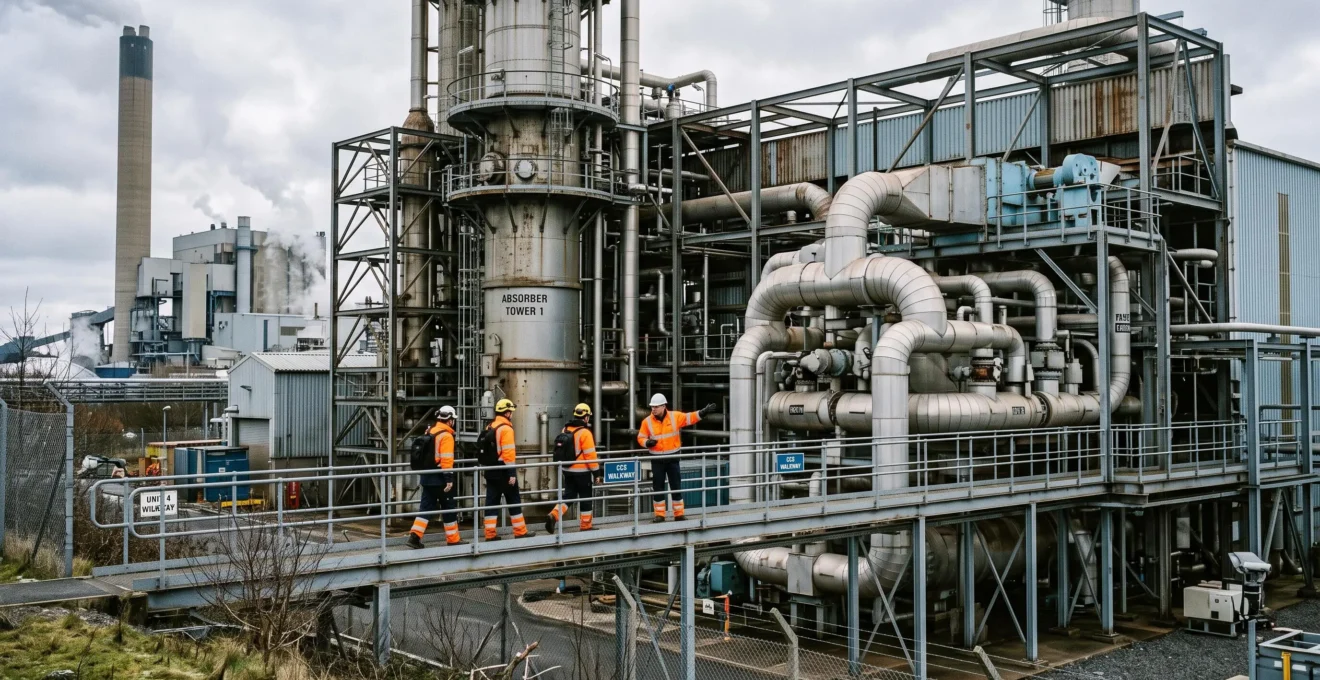
Carbon capture is creating commercial opportunities between the United Kingdom and Canada because the two markets combine different industrial strengths, established engineering capabilities and complementary approaches to carbon dioxide transport and geological storage. For businesses, the opportunity extends beyond operating capture facilities: it includes technology licensing, equipment supply, engineering, infrastructure development, monitoring and specialist financial services.
The UK is developing carbon capture, utilisation and storage (CCUS) networks around industrial clusters, while Canadian provinces such as Alberta already have experience operating large-scale CO2 pipelines and storage facilities. These differences create potential routes for suppliers and investors to enter each other’s markets.
However, a commercially attractive project needs more than functioning capture technology. Its viability depends on emissions volumes, transport access, storage contracts, regulatory permissions, financial support and credible carbon accounting. Companies assessing UK-Canada opportunities should therefore evaluate the entire carbon management chain before committing capital.
UK-Canada carbon capture: the commercial essentials
- Industrial carbon capture creates opportunities for equipment manufacturers, engineering companies, infrastructure operators and specialist service providers, not only major emitters.
- Project economics depend on the combined cost and availability of capture, transport and storage, alongside enforceable contracts and applicable public support.
- Cross-border partnerships are most valuable when they address a specific capability gap and allocate technology, infrastructure, financial and long-term liability risks clearly.
- Why Are Heavy Industries Investing in Carbon Capture Technologies?
- How Can Companies Assess Whether Carbon Capture Fits an Industrial Site?
- Capture, Transport or Storage: Which Carbon Project Role Fits Your Business?
- The Infrastructure Risks That Can Stall a Carbon Capture Project
- When Should a Carbon Capture Project Seek Cross-Border Partners?
- How Can Businesses Evaluate Renewable Energy Opportunities Across Both Markets?
- The Greenwashing Risks That Can Weaken a Cross-Border Finance Project
- How Can Green Finance Create New UK-Canada Investment Opportunities?
Why Are Heavy Industries Investing in Carbon Capture Technologies?
Heavy industries invest in carbon capture to manage emissions that are difficult to eliminate through electrification or energy efficiency alone. For cement, chemicals, refining and certain steelmaking processes, capture can support regulatory compliance, protect access to customers seeking lower-carbon products and preserve the commercial value of existing industrial assets. Its attractiveness depends on total costs, emissions obligations and available infrastructure.
Industrial facilities face different decarbonisation pressures depending on their production processes and jurisdictions. Cement manufacturing is a particularly relevant example because producing clinker releases CO2 through chemical reactions as well as fuel combustion. Replacing fossil-fuel heat alone cannot eliminate these process emissions.
In the UK, industrial cluster development is intended to connect multiple emitting facilities to shared transport and storage infrastructure. Government planning has identified seven major industrial clusters accounting for approximately half of UK industrial emissions.
£21.7 billion
UK government funding made available for initial CCUS projects, announced in October 2024. This is a funding commitment, not an amount already fully spent or a guarantee of support for individual projects.
The East Coast Cluster transport and storage network and Net Zero Teesside reached financial close in December 2024. HyNet’s transport and storage network reached financial close in April 2025. These milestones establish greater commercial certainty for specific infrastructure developments, although they do not mean every associated capture facility is operational. Other cluster projects remain subject to their own financing and development milestones.
Canada offers a different industrial context. Alberta’s carbon capture experience includes gas processing, oil sands upgrading, dedicated geological storage and CO2 transport infrastructure. Canadian projects must be assessed against applicable federal and provincial emissions requirements, rather than assuming that one national carbon-pricing mechanism applies uniformly to every industrial activity.
The business case can be divided into two categories:
- Compliance and competitiveness: capture can reduce exposure to applicable industrial emissions obligations and help producers meet contractual product-carbon requirements.
- Commercial value creation: projects may generate income through CO2 transport services, qualifying industrial utilisation, storage services or customer demand for lower-emissions products.
Enhanced oil recovery represents another commercial use of captured CO2 in Canada, but it requires a separate assessment of lifecycle emissions and project economics. Commercial utilisation does not automatically qualify for clean-economy investment incentives or establish a net emissions reduction.
For companies outside the industrial operator’s balance sheet, the wider supply chain may be particularly attractive. Capture projects require compressors, separation equipment, engineering design, installation, instrumentation, maintenance, emissions monitoring and specialised logistics.
Before pursuing contracts, suppliers should distinguish projects with committed infrastructure and funding from those still dependent on future policy decisions, engineering studies or customer agreements. That distinction leads directly to the question of site-level feasibility.
How Can Companies Assess Whether Carbon Capture Fits an Industrial Site?
Companies should screen an industrial site for carbon capture by examining emissions concentration, annual CO2 volume, available energy, proximity to transport and storage infrastructure, and the remaining operating life of the facility. They must then calculate the complete capture-to-storage cost and test whether contractual revenues or avoided emissions costs can support the investment.
The initial technical assessment should establish whether CO2 is released through a concentrated process stream or diluted combustion exhaust. A relatively concentrated stream can require a different separation system and energy input from a dilute flue gas stream containing contaminants.
Five screening variables are especially important:
- Emissions profile: measured annual CO2 output, concentration, operating hours, contaminants and expected changes in production.
- Technology compatibility: the capture method’s ability to operate with the actual flue gas composition, temperature and pressure.
- Energy integration: available steam, heat recovery, electricity capacity and the emissions associated with additional energy demand.
- Infrastructure access: distance to an accessible pipeline or shipping terminal, storage availability, connection conditions and tariff exposure.
- Asset life: remaining years of operation, planned shutdowns, retrofit constraints and realistic capital recovery periods.
Retrofits present different technical and commercial challenges from new-build installations. Existing cement and steel facilities may have restricted space, integrated heat systems and expensive shutdown requirements. Gas-processing and certain hydrogen-production streams can offer different separation conditions. A new-build facility can incorporate capture interfaces into the original design, but still needs suitable transport and storage access.
Geography changes the outcome. A UK facility near a developing industrial cluster may be able to evaluate shared-network access and relevant industrial carbon capture support arrangements. The exact business model depends on the type of facility and infrastructure involved; regulated transport and storage arrangements should not be assumed to provide the same support as industrial capture contracts.
In Canada, businesses can benchmark opportunities against established infrastructure such as the Alberta Carbon Trunk Line or operating experience at the Quest project. Saskatchewan’s Boundary Dam project provides a further reference for evaluating coal-power capture experience, although the technical and commercial lessons cannot automatically be transferred to other sectors.
The central financial mistake is comparing projects only by the cost of capturing a tonne of CO2. Compression, pipeline access, transport tariffs, injection costs, measurement, monitoring, verification and eventual closure obligations may materially change the total expenditure.
Five deliverables for an initial carbon capture feasibility screen
- Compile measured emissions data, including concentration, annual volume and operating variability; produce a verified emissions baseline.
- Identify technically compatible capture configurations and their energy requirements; prepare a preliminary technology options matrix.
- Map accessible transport routes, storage options, connection conditions and regulatory constraints; produce an infrastructure access map.
- Estimate capital expenditure, operating costs, downtime exposure and remaining plant life; produce an indicative whole-chain cost model.
- Test financing, carbon-price and infrastructure-delay scenarios; deliver a documented preliminary investment recommendation with unresolved assumptions.
A positive screening result is not a final investment decision. It indicates that sufficient technical, infrastructure and commercial conditions exist to justify deeper feasibility work and a clearer choice of business role.
Capture, Transport or Storage: Which Carbon Project Role Fits Your Business?
The most suitable position in the carbon capture value chain depends on a company’s strongest capabilities. Industrial operators and process technology firms may focus on capture; pipeline and infrastructure companies may favour transport; and businesses with geological, subsurface and regulatory expertise may pursue storage. Each activity requires different capital commitments, contracts and risk management capabilities.
Although these activities are connected operationally, they should not be treated as one interchangeable business model. Their risks arise at different points in the project lifecycle.
| Assessment | Capture | Transport | Storage |
|---|---|---|---|
| Best-aligned capabilities | Industrial operations, process engineering, equipment manufacturing | Pipeline engineering, infrastructure ownership, logistics and network operations | Geology, reservoir engineering, subsurface monitoring and permitting |
| Primary investment exposure | Capture equipment, energy integration, installation and operation | Network construction, compression and operating infrastructure | Site characterisation, wells, injection and monitoring systems |
| Principal commercial risk | Capture performance, energy costs, plant availability | Insufficient contracted throughput or delayed customer connections | Reservoir performance, regulatory obligations and long-term liability |
| Key contractual requirement | Performance guarantees and transport access | Capacity commitments and delivery specifications | Storage rights, injection terms and liability allocation |
Capture technology suppliers can participate without owning the industrial facility. Their commercial advantage may lie in separation efficiency, equipment reliability, modular design or operating support. However, equipment performance is only one component of the customer’s overall decarbonisation economics.
Transport businesses face an infrastructure utilisation problem. A technically sound pipeline may struggle commercially if industrial emitters postpone investment or fail to deliver contracted CO2 volumes. Revenue models must therefore address volume uncertainty and the financial condition of connected customers.
Storage operators face a different timeline. They need geological evidence, regulatory authorisations, measurement systems and provisions for closure and post-closure responsibilities. These obligations may continue after routine injection operations end.
Regulation is also jurisdiction-specific. UK offshore CO2 storage activities are subject to applicable licensing, permitting and monitoring arrangements. In Canada, subsurface resource management and relevant storage regimes involve provincial law, with important distinctions between provinces. Liability transfer or government assumption of post-closure responsibilities must never be presumed without checking the particular regulatory and contractual framework.
A practical positioning test is to identify which resource competitors would find most difficult to replicate: proprietary separation technology, access to capital, rights over infrastructure corridors, specialist geology, permitting experience or relationships with major emitters.
Entering the value chain where those advantages are strongest reduces the temptation to assume unfamiliar operational or regulatory responsibilities. It also clarifies which infrastructure dependencies require contractual protection.
The Infrastructure Risks That Can Stall a Carbon Capture Project
Carbon capture projects can stall when capture facilities, pipelines and storage sites fail to progress on compatible schedules. A capture plant cannot deliver its intended emissions benefit without reliable downstream infrastructure. The principal risks are delayed permits, unavailable transport capacity, storage development setbacks, insufficient contracted volumes and counterparties failing to secure financing.
Shared networks can improve commercial feasibility by distributing infrastructure costs across multiple users. However, this structure creates dependency between businesses that may have different owners, development schedules and financing arrangements.
A capture facility could complete its engineering and secure equipment suppliers while its intended storage operator still awaits regulatory approval. Conversely, a transport network could face commercial pressure if industrial customers delay their projects.
UK cluster sequencing illustrates why infrastructure readiness and individual project readiness must be assessed separately. Financial close for a network can increase confidence in that network without establishing the readiness of every future connection.
In Canada, pipeline routes, surface access, geological characterisation, injection approvals and community engagement may affect development schedules. The precise process depends on the province, project configuration and applicable authorities.
Alberta provides a useful operational reference. Its Carbon Trunk Line extends approximately 240 kilometres and has a designed maximum capacity of 14.6 million tonnes of CO2 per year. This is a design figure, not evidence that the pipeline transports that volume annually.
Operational reference: Alberta Carbon Trunk Line
The Alberta Carbon Trunk Line began commercial operations in 2020, connecting industrial CO2 capture with transportation and sequestration activities in Alberta.
According to the Alberta government’s published information, the sequestration site operator reported more than 8 million tonnes of CO2 captured and sequestered cumulatively since operations began. This operator-reported historical total is distinct from annual throughput and from the pipeline’s maximum designed capacity.
The example demonstrates an operating capture-to-transport-to-storage chain, but does not establish the profitability or transferability of its commercial structure to another project.
Companies should convert infrastructure uncertainty into explicit contractual conditions. These may include minimum capacity reservations, acceptable CO2 quality specifications, completion milestones, allocation of delay costs and remedies for prolonged unavailability.
Capital expenditure should also be staged. Significant capture commitments may be made conditional on transport and storage providers achieving defined investment, permit and contractual milestones, where practical.
Fallback options deserve scrutiny rather than optimistic assumptions. Alternative storage sites require their own geological and regulatory assessments. An alternative CO2 purchaser may have insufficient demand, unsuitable technical requirements or a utilisation pathway that fails the project’s emissions objectives.
Once network reliability and delivery schedules are understood, cross-border partners can be selected for the specific risks and capabilities they are positioned to manage.
When Should a Carbon Capture Project Seek Cross-Border Partners?
A carbon capture project should seek UK-Canada partners when a clearly identified capability gap threatens its development or commercial performance. Typical triggers include missing separation technology, limited engineering capacity, insufficient infrastructure expertise or the need for a locally eligible project company. Partnerships are most effective after the project has established its emissions base, infrastructure needs and negotiating priorities.
The UK and Canada offer potentially complementary industrial capabilities. UK firms may bring process engineering, offshore subsurface experience and expertise developed through industrial cluster planning. Canadian businesses may contribute experience in onshore geological storage, pipeline operations, industrial capture and provincial regulatory processes.
These strengths do not mean that every British supplier is suited to a Canadian project, or that Canadian storage expertise automatically transfers to UK offshore geology. Commercial compatibility must be demonstrated through technical and contractual due diligence.
The timing of a partnership also depends on the financing framework.
- UK projects: commercial discussions may need to align with the relevant cluster development stage, infrastructure access arrangements and government-supported business model.
- Canadian projects: investors must examine provincial resource and permitting requirements alongside any federal or provincial investment incentives.
The Canadian federal CCUS Investment Tax Credit is particularly relevant to qualifying projects. Its stated eligible expenditure period extends from 1 January 2022 to 31 December 2040, subject to the legislation and detailed eligibility requirements.
Eligible activities can include capture, transportation and qualifying geological or industrial storage applications. Importantly, enhanced oil recovery is not an eligible use under the federal CCUS tax credit, even though it exists as a commercial activity in Alberta.
The Canada Revenue Agency‘s CCUS Investment Tax Credit eligibility rules provide the relevant starting point for evaluating the federal framework. A UK business entering a Canadian consortium must assess the eligibility of the actual Canadian taxpayer, project and expenditures, rather than assuming foreign participation itself creates entitlement.
Companies should define their contribution before negotiating consortium membership. That means identifying proprietary technology, intellectual property rights, capital commitments, local delivery obligations, performance guarantees and acceptable exposure to long-term liabilities.
Premature participation can weaken negotiating leverage. A proposed project without secure emissions volumes, land access or an infrastructure route may offer partners an uncertain opportunity while asking them to accept substantial development risk.
A more defensible approach is to use preliminary technical cooperation or conditional commercial agreements until the project reaches an agreed readiness threshold. Exclusive rights and long-term commitments should reflect demonstrable contributions and clearly allocated responsibilities.
Once roles are established, the partnership should examine a further dependency: whether the energy used by capture and related low-carbon industrial processes supports both project economics and credible emissions claims.
How Can Businesses Evaluate Renewable Energy Opportunities Across Both Markets?
Businesses should evaluate UK and Canadian renewable energy opportunities by examining electricity cost, grid emissions intensity, supply reliability, interconnection constraints and proximity to industrial demand. For carbon capture and hydrogen projects, renewable electricity creates value when it reduces operational emissions or energy expenditure without compromising availability. The best location depends on local energy systems and infrastructure access.
Carbon capture consumes energy through separation, regeneration, compression and associated equipment. If additional energy comes from emissions-intensive sources, the project’s net climate benefit may be lower than its gross capture volume suggests.
This creates a commercial link between CCS and clean electricity procurement. Businesses supplying renewable generation, storage, grid services or power management systems may find opportunities around industrial decarbonisation projects even when they do not provide capture equipment.
Market evaluation should not compare the UK against Canada as though either were a single uniform electricity system. Canadian electricity markets and generating mixes differ significantly by province. A project’s location within Alberta, Ontario, Quebec or another province can change the technical and economic assessment.
| Decision factor | United Kingdom | Canada |
|---|---|---|
| Electricity emissions | Assess the relevant grid supply and procurement structure | Use province-specific grid and supply information |
| Cost exposure | Review wholesale volatility, network charges and power purchase terms | Review provincial tariffs, market arrangements and contract structures |
| Connection risk | Examine available grid capacity and connection milestones | Assess interconnection requirements with the relevant provincial system |
| Industrial integration | Evaluate proximity to cluster facilities and transport networks | Evaluate access to industrial hubs, power supply and suitable storage geology |
| Reliability | Assess firm supply, backup and flexibility requirements | Assess seasonal demand, supply constraints and local grid reliability |
Renewable power purchase agreements can help manage electricity-related emissions and certain price risks. However, buyers must assess contract duration, delivery arrangements, matching methodology and the distinction between contractual energy attributes and actual operational electricity supply.
Location can also offer commercial advantages. A new hydrogen production or carbon-management processing facility may benefit from proximity to dependable low-carbon electricity and appropriate storage infrastructure.
That flexibility is more limited for existing industrial emitters. Moving a capture unit away from the emissions source introduces CO2 transport, gas-handling and potentially additional infrastructure requirements. The alternative must therefore be evaluated across the whole system, not merely through electricity prices.
For financiers and customers, the relevant metric is the project’s demonstrable net emissions performance. Gross captured CO2 alone does not capture the effects of additional electricity, upstream energy supply or transport operations.
A defensible energy strategy also improves the quality of the project’s environmental claims, which becomes essential when seeking sustainability-linked finance or marketing lower-carbon industrial products.
The Greenwashing Risks That Can Weaken a Cross-Border Finance Project
Greenwashing can weaken UK-Canada carbon capture financing when project documents overstate emissions reductions, misrepresent storage permanence or imply that environmental benefits have been independently verified when they have not. Investors need evidence distinguishing CO2 captured, transported, permanently stored and ultimately avoided or removed. Misleading claims may create regulatory, contractual and reputational exposure.
Three reporting failures deserve particular attention.
- Unverifiable capture claims: using equipment design capacity, projected operating performance or unsupported estimates as evidence of actual captured volumes.
- Double counting: allocating the same environmental benefit to multiple parties or instruments without a defensible accounting and ownership framework.
- Unsupported permanence claims: describing temporary utilisation, unspecified offsets or unverified storage activities as equivalent to demonstrated long-term geological storage.
These failures can emerge when project developers, transport providers, storage operators and lenders use different reporting boundaries. A capture facility may report the CO2 entering a pipeline, while investors require evidence of final injection, storage monitoring and lifecycle emissions.
Carbon accounting must therefore distinguish physical quantities from the environmental claims attached to them. One tonne captured is not automatically one tonne of net avoided emissions, and neither quantity necessarily constitutes a verified carbon removal credit.
The regulatory context matters. In the UK, the Financial Conduct Authority‘s anti-greenwashing rule has applied since 31 May 2024 to firms within its regulatory scope. It requires relevant sustainability-related claims about products and services to be fair, clear and not misleading.
The FCA guidance on the anti-greenwashing rule is directly relevant to authorised financial firms making sustainability representations. It should not be interpreted as imposing identical FCA obligations on every industrial operator or Canadian company.
Canadian disclosure and securities obligations require separate jurisdictional analysis, including applicable provincial securities requirements and the status of relevant sustainability reporting standards. International standards may inform disclosure quality without automatically becoming mandatory for every Canadian issuer.
A project verification framework should connect metered capture volumes to transport records, injection data, storage monitoring and documented emissions boundaries. Independent assurance should examine the actual claim being made, not simply the presence of capture equipment.
Contracts may also allocate responsibility for reporting errors, monitoring failures and inaccurate sustainability statements. The financial consequences depend on the wording of relevant agreements and applicable law: covenant breaches, pricing adjustments or investment restrictions should be treated as possible contractual outcomes, not automatic penalties.
For cross-border projects, a common reporting protocol helps prevent partners from presenting incompatible emissions figures to investors, customers and authorities.
Reliable carbon accounting is not merely a compliance exercise. It helps distinguish projects with measurable environmental performance from proposals whose financing story depends on claims that have not yet been demonstrated.
Key investment takeaways
- Separate technically feasible capture projects from those with sufficiently advanced transport, storage and contractual arrangements to support financing.
- Examine public incentives alongside eligible expenditures, qualifying project structures and long-term operating obligations.
- Require measurable emissions performance and explicit allocation of infrastructure, counterparty and storage risks before treating a project as investment-ready.
How Can Green Finance Create New UK-Canada Investment Opportunities?
Green finance can create UK-Canada investment opportunities by funding qualifying capture equipment, transport networks, geological storage and supporting low-carbon infrastructure. Commercial opportunities also arise in project structuring, insurance, engineering assurance and emissions verification. The strongest financing candidates combine credible technology, reliable infrastructure, appropriate public support and identifiable revenue streams rather than relying solely on anticipated carbon prices.
The two countries offer different routes for allocating financial risk.
UK CCUS policy includes government-supported commercial arrangements intended to address barriers to initial deployment. Depending on the activity and applicable model, these may include capital support, revenue support and regulated infrastructure arrangements. These mechanisms should not be described as a universal carbon contract for difference available to every capture project.
In Canada, the federal CCUS investment tax credit provides a potential capital incentive for qualifying expenditures. Provincial measures may also be relevant. Alberta, for example, has described a Carbon Capture Incentive Program involving a 12% grant rate for eligible new capital costs, although detailed implementation and eligibility must be confirmed before incorporating that figure into a binding financial model.
Neither framework removes the need for private capital or makes every project commercially viable. Investors must assess the actual support agreement, eligible costs, timing of payments, tax treatment and obligations attached to the proposed project.
For a UK investor entering Canada, the financing structure may involve equity participation in a qualifying Canadian project company, technology supply, debt financing or a commercial development partnership. These arrangements have different tax, regulatory and operational implications. Incentive entitlement cannot be inferred from the investor’s nationality alone.
The investment committee’s central question is whether project cash flows can remain viable under realistic operating and market conditions.
| Investment criterion | More financeable position | Higher-risk position |
|---|---|---|
| Revenue support | Executed or sufficiently advanced contractual support with identifiable counterparties | Dependence on uncertain future carbon prices or uncommitted buyers |
| Technical performance | Demonstrated technology applicability and defined performance guarantees | Unproven performance at the intended industrial scale |
| Infrastructure | Credible transport and storage route with aligned development milestones | No committed downstream infrastructure or unclear connection rights |
| Public incentives | Documented eligibility assessment and realistic payment assumptions | Financial model assuming incentives without confirmed qualification |
| Long-term liabilities | Contractual allocation supported by regulatory and financial analysis | Unresolved monitoring, closure or storage responsibility |
| Environmental claims | Defined measurement boundaries and verifiable performance evidence | Reliance on design capacity or unsupported carbon credit assumptions |
One possible investment structure is a consortium involving a UK engineering supplier and a Canadian industrial operator. In this hypothetical scenario, the operator contributes access to its emissions source and local project development capabilities, while the UK supplier provides capture technology and performance support. Financing would remain conditional on satisfactory technology testing, storage arrangements, incentive eligibility and credit assessment.
This example illustrates how capabilities can be combined; it is not an identified transaction or evidence that the structure automatically qualifies for government support.
Financial services firms may also find opportunities without owning capture assets. Specialist insurance, long-term liability assessment, construction risk management, carbon accounting assurance, independent engineering reviews and cross-border transaction advisory are all potentially relevant services.
Such services become more valuable where lenders need to distinguish different forms of risk: construction completion risk, operating performance risk, transport counterparty risk and storage obligations should be evaluated separately.
Project maturity remains the decisive consideration. A policy-backed initiative with advanced infrastructure contracts is fundamentally different from an early-stage proposal whose business model relies on future demand for carbon credits. Both may offer opportunities, but they require different capital structures, return expectations and risk limits.
The practical next step is to prepare a project-specific investment memorandum covering emissions performance, infrastructure commitments, incentive eligibility, contracted revenues, financing sensitivity and liability allocation. That document provides a concrete basis for approaching UK or Canadian lenders, strategic investors and industrial partners.
Can a UK company participate in a Canadian carbon capture project?
Yes, subject to applicable investment, corporate, tax, contractual and regulatory requirements. A UK company may participate as a technology supplier, engineering contractor, investor or consortium partner. Participation does not automatically establish eligibility for Canadian public incentives; the qualifying project structure and expenditures must be assessed separately.
Does selling captured CO2 for enhanced oil recovery qualify for Canada’s federal CCUS tax credit?
No. Enhanced oil recovery is an ineligible use under the federal CCUS Investment Tax Credit. The existence of commercial CO2 enhanced oil recovery operations does not change that distinction. Projects must separately establish whether their capture, transport and qualifying storage or utilisation activities satisfy the applicable eligibility requirements.
Must carbon capture projects be located close to geological storage sites?
Not necessarily. Captured CO2 can be transported to a suitable storage location, provided appropriate infrastructure, regulatory approvals and contractual access are available. However, greater transport complexity can increase cost and delivery risk. Site selection should compare the complete capture, compression, transport and storage system.
Can smaller engineering or technology businesses enter the CCUS market without owning infrastructure?
Yes. Specialist businesses can provide equipment, process engineering, instrumentation, emissions measurement, monitoring, maintenance, technical assurance or other contracted services. Their commercial prospects depend on project procurement schedules, technical qualification requirements and the financial maturity of prospective customers.
What evidence should a lender request before financing a carbon capture project?
A lender should seek a credible technical design, independently reviewable emissions estimates, a comprehensive cost model, transport and storage arrangements, relevant permits, counterparty assessments and documented public incentive assumptions. It should also examine contractual revenues, performance guarantees, monitoring requirements and responsibility for long-term liabilities. The required depth of evidence will depend on the financing stage and structure.