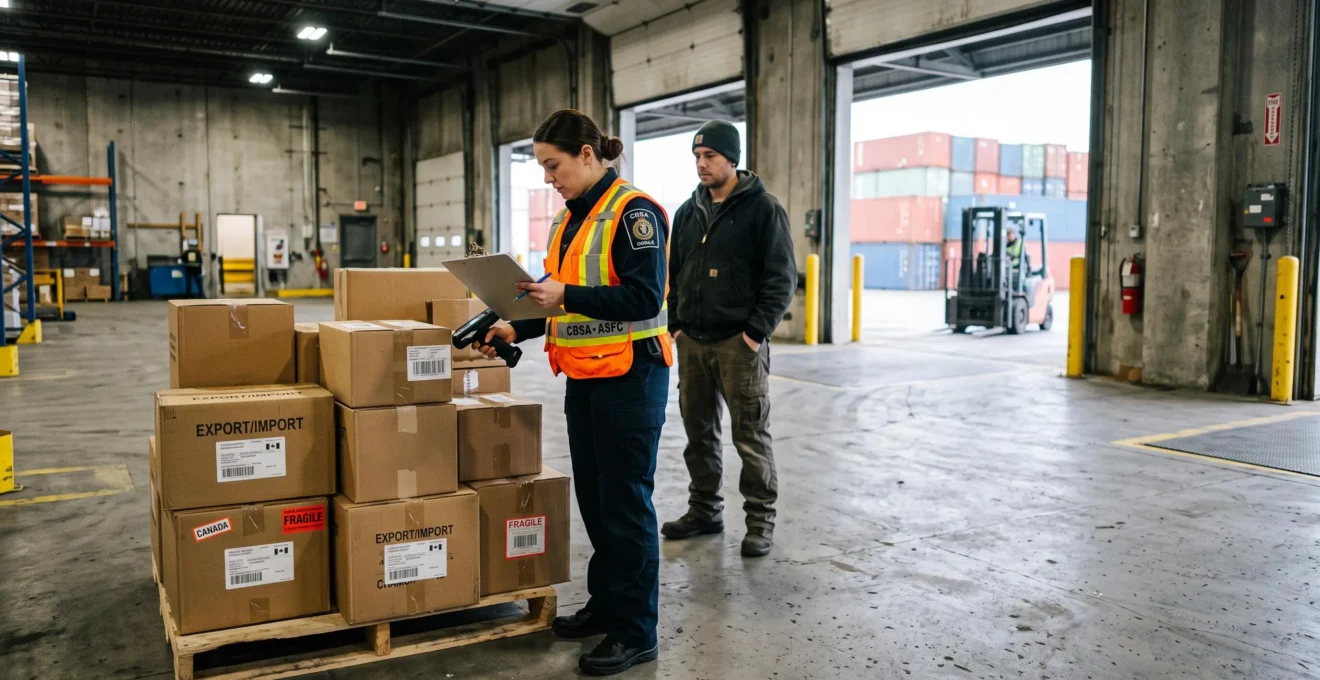
The Canada Border Services Agency (CBSA) controls the entry of commercial goods into Canada by reviewing shipment information, assessing customs requirements, administering applicable trade measures and determining whether imported goods can be released. Its responsibilities extend beyond collecting import duties: commercial shipments may also be subject to inspections, import restrictions, product-specific controls and requirements administered on behalf of other Canadian authorities.
For UK exporters and Canadian importers, this means customs clearance begins well before a shipment reaches a Canadian port, airport or land border. A correctly calculated tariff does not guarantee release if the goods lack appropriate documentation or fail to meet applicable regulatory conditions.
Successful preparation involves identifying the importer of record, establishing the correct tariff classification and customs value, checking origin and product compliance, and coordinating advance information with the carrier or freight forwarder. Understanding these distinct responsibilities helps businesses avoid preventable interruptions without assuming that advance filing automatically guarantees clearance.
CBSA commercial clearance: the essentials
- The CBSA assesses customs information and enforces applicable import controls; tariff accuracy alone does not establish compliance.
- UK exporters should prepare accurate invoices, product descriptions, origin evidence and regulatory documentation before dispatch.
- Canadian importers remain accountable for their customs obligations when using a broker, while advance carrier reporting and early document checks help reduce avoidable delays.
- Why Does the CBSA Review More Than Tariffs on Commercial Imports?
- How Can UK Exporters Prepare Goods for CBSA Clearance in Canada?
- Direct CBSA Filing or Customs Broker: Which Option Fits a Canadian Importer?
- CBSA Compliance Errors That Can Delay Commercial Goods Entering Canada
- When Should Importers Prepare CBSA Information Before Goods Reach Canada?
- How Can Businesses Prepare for Customs Clearance Before a Shipment Arrives?
- Border Agency Mistakes That Can Turn a Routine Shipment Into a Lengthy Hold
- How Can Businesses Check Local Product Standards Before Selling in the UK or Canada?
Why Does the CBSA Review More Than Tariffs on Commercial Imports?
The CBSA reviews more than customs duties because commercial imports must comply with multiple Canadian laws and government programmes. Alongside tariff classification, valuation and origin, the agency may examine admissibility, security risks, permits and product-specific restrictions. Consequently, goods can be correctly classified and fully duty-paid yet remain ineligible for release until another regulatory requirement is satisfied.
The customs process therefore has two connected but distinct dimensions. The first establishes the fiscal treatment of an import: what the goods are, where they originate, their value for duty and the applicable tariff treatment. The second determines whether the goods can legally enter Canada under relevant non-tariff requirements.
Depending on the merchandise, the CBSA may administer requirements associated with the Canadian Food Inspection Agency (CFIA), Health Canada, import and export controls, intellectual property enforcement or applicable trade sanctions. Different programmes may require different documents, permits or inspections.
For example, an imported packaged food product may have a valid tariff classification but still require food-related declarations, appropriate labelling or other CFIA compliance measures. An electrical appliance may raise different questions concerning product safety and certification. Goods potentially subject to sanctions require separate verification of the applicable restrictions.
Customs release and full product compliance are not interchangeable. The absence of a border hold does not establish that a product meets every requirement governing its subsequent Canadian sale, distribution or use.
Documentation also affects the CBSA’s ability to verify an entry. An invoice with an incomplete product description, unexplained price or inconsistent quantity may require clarification before the agency can determine whether the declaration is accurate.
Consider a hypothetical shipment containing several industrial components. If one invoice line describes the merchandise only as « parts », the importer may need to obtain technical specifications before the goods can be properly assessed. If those details have already been assembled and made available to the responsible filing party, the discrepancy may be easier to resolve. Neither situation guarantees a particular inspection outcome.
This explains why clearance times can differ even for superficially similar shipments. The applicable regulatory programme, quality of information, risk assessment and any examination requirements can all affect the release process.
Once the applicable controls are understood, the next priority is ensuring that the UK exporter provides the Canadian importer with documentation capable of supporting both customs and product-specific requirements.
How Can UK Exporters Prepare Goods for CBSA Clearance in Canada?
UK exporters can prepare for CBSA clearance by producing an accurate commercial invoice, confirming the Canadian tariff classification and customs valuation, establishing the goods’ origin and checking applicable import restrictions. The documents should describe the physical shipment consistently. The Canadian importer or its authorised customs broker can then use that information to support the required release and accounting procedures.
The commercial invoice is a central document. Under CBSA Memorandum D1-4-1 on commercial invoice requirements, most commercial shipments require a commercial invoice containing prescribed information, a qualifying invoice supplemented by Form CI1, or a completed Canada Customs Invoice. Specific exceptions apply, including certain lower-value and duty-free shipments.
Businesses should confirm that the documentation identifies the vendor, purchaser or consignee as applicable, describes the merchandise accurately, specifies quantities and prices, states the currency, and includes the origin and other relevant details. The information must support the declared customs value rather than merely reproduce an internal sales order.
The memorandum was originally issued in 2013 and is marked as under review following the transition to the CBSA Assessment and Revenue Management system (CARM). Importers should therefore confirm current electronic filing requirements rather than assume that every historical procedural detail remains unchanged.
Tariff classification also requires attention. The exporter can propose a Harmonized System (HS) classification, but the Canadian import declaration must use the appropriate Canadian tariff classification. The product’s composition, purpose, characteristics and relevant tariff rules determine which classification applies.
Businesses can consult Canada’s Customs Tariff and the relevant classification guidance, then retain technical datasheets explaining the chosen code. For recurring shipments of goods with uncertain classification, an advance ruling may offer greater certainty when the application meets CBSA requirements.
UK exporters must also distinguish between tariff classification, non-preferential origin and preferential origin. These concepts are related but serve different purposes.
UK-origin goods do not qualify for CUSMA preferences simply because they enter Canada. However, UK exporters should not assume that no preferential tariff treatment is available. The Canada-UK Trade Continuity Agreement entered into force on 1 April 2021, and the Comprehensive and Progressive Agreement for Trans-Pacific Partnership (CPTPP) entered into force between Canada and the UK on 1 September 2026.
As explained in the Canadian government’s Canada-United Kingdom trade relations and agreements guidance, these agreements provide distinct routes to preferential market access. Eligibility must be checked against the relevant product-specific rules of origin and documentary requirements. Shipment from a UK warehouse does not, by itself, establish UK preferential origin.
Finally, product compliance needs separate attention. Bilingual English-French labelling may be mandatory for particular consumer products, subject to the relevant exemptions and sector-specific rules. Food products, cosmetics, electrical equipment and other regulated categories can have additional requirements. Not every commercial shipment is subject to identical labelling rules, so the product category and intended use must be verified.
Once the exporter has prepared reliable product and transaction information, the Canadian importer must decide who will use it to complete the customs process.
Direct CBSA Filing or Customs Broker: Which Option Fits a Canadian Importer?
Direct filing may suit Canadian importers with predictable products, established classifications and sufficient in-house customs expertise. A licensed customs broker may be more practical when shipments are frequent, merchandise is varied or regulatory requirements are complex. The decision should account for total administrative costs, staff capacity and compliance risk rather than brokerage fees alone.
Both approaches require the importer to establish appropriate Canadian importing arrangements. This generally includes a business number with an import-export programme account and the relevant CARM registration and account access arrangements.
A broker can prepare and submit customs information, assist with release procedures, maintain documentation and respond to certain CBSA enquiries within the scope of its authorisation. Its services are commercial arrangements, and fees vary according to the provider and work involved.
Appointing a broker does not transfer every customs obligation away from the importer. The importer of record retains important responsibilities for customs accounting, duties and taxes, records and required corrections. A broker’s contractual responsibilities and any separate legal liability should not be confused with the importer’s statutory obligations.
The decision becomes clearer when the two approaches are compared across operational factors.
| Decision factor | Direct CBSA filing | Licensed customs broker |
|---|---|---|
| Internal expertise | Requires staff familiar with Canadian customs procedures and applicable systems. | Provides access to specialised filing expertise, but importer oversight remains necessary. |
| Product complexity | More manageable when classifications and regulatory requirements are stable. | May be preferable for diverse or regulated product portfolios. |
| Administrative cost | Staff time, systems, training, record keeping and compliance management. | Brokerage fees plus internal coordination and information verification. |
| Shipment volume | Potentially efficient when recurring processes justify internal investment. | Flexible for businesses without dedicated customs personnel. |
| Error management | Corrections and procedural work managed directly. | Broker can assist, but does not eliminate importer accountability. |
There is no universal number of monthly shipments at which direct filing becomes less expensive than brokerage. A company importing a small number of technically complex products may need more specialist assistance than one receiving numerous shipments of identical, well-documented goods.
A practical intermediate approach is to use a broker for initial shipments while building an internal classification register, documenting valuation decisions and learning the applicable customs procedures. If operations become predictable, the importer can reassess whether to internalise certain tasks.
Before changing arrangements, the business should confirm its ability to access the relevant CBSA systems, meet applicable reporting obligations, retain records and handle corrections. Broker selection should also include a clear agreement defining document exchange, authorisation, fees and escalation responsibilities.
Whichever arrangement is chosen, the same underlying customs data must be correct. Classification, valuation and documentary mistakes can still cause delays or later assessments.
CBSA Compliance Errors That Can Delay Commercial Goods Entering Canada
Common compliance problems include incorrect tariff classifications, unsupported customs values, incomplete invoices, questionable origin claims and missing product-specific documents. The CBSA may identify discrepancies through submitted records, targeted verification or examination. The consequences depend on the issue and can range from requests for clarification to delayed release, reassessment or administrative penalties.
Classification errors can arise when products are described using generic commercial terminology rather than the information required by the Canadian Customs Tariff. A component’s material, function or technical characteristics may change its classification. An incorrect code can affect the duty rate and whether additional import measures apply.
Customs valuation mistakes are another significant risk. A commercial selling price is not automatically identical to the value for duty. Depending on the applicable valuation method and transaction terms, adjustments may be required. Freight, insurance, assists, royalties and other charges must be examined under the relevant valuation rules rather than universally added or excluded.
Origin errors create a different problem. Goods dispatched from the UK may have been manufactured elsewhere, and preferential origin requires satisfaction of the selected trade agreement’s rules. The importer needs an evidential basis for the origin and tariff treatment declared.
Regulatory discrepancies may also affect entry. Missing permits, unresolved food requirements, incorrect labels or absent safety documentation can prevent a shipment from being released or require further assessment by the responsible authority.
The potential consequences can develop in stages:
- Clarification or correction: the responsible party supplies missing information or corrects an identifiable mistake.
- Release delay: the shipment remains under customs control while the relevant issue is resolved.
- Examination or additional verification: officials seek further evidence or inspect goods where warranted.
- Post-release reassessment: a later compliance verification may establish additional duties or other amounts owing.
- Administrative enforcement: qualifying contraventions may result in penalties under the Administrative Monetary Penalty System (AMPS).
An apparently successful release does not necessarily close the compliance risk. For example, a hypothetical importer might repeatedly classify a product under the same incorrect tariff item without an immediate problem at the border. A subsequent verification could require corrections and additional duty payments covering applicable earlier transactions.
Good-faith mistakes and deliberate misstatements are not necessarily treated alike, but an error being unintentional does not automatically prevent a reassessment or administrative penalty. The relevant statutory provisions, compliance history and circumstances determine the consequences.
Five checks before releasing a commercial shipment for dispatch
- Compare the commercial invoice with the sales order and packing list; produce a reconciled document set showing matching goods, quantities and transaction references.
- Verify the Canadian tariff classification against the product specifications; retain a classification register with the supporting technical evidence.
- Review the valuation method, currency, commercial terms and relevant charges; save a documented customs-value calculation or valuation review.
- Confirm the declared country of origin and any preferential origin claim; retain the applicable origin evidence in the shipment file.
- Check product-specific permits, labelling, certification and carrier data; complete a dated compliance checklist identifying the responsible reviewer.
The purpose of this review is not to predict every CBSA intervention. It is to ensure the business can explain its declarations and respond efficiently when additional evidence is requested.
Even accurate paperwork can become a bottleneck if it reaches the carrier, broker or border authorities too late. The next variable is the timing of information transmission.
When Should Importers Prepare CBSA Information Before Goods Reach Canada?
Importers should begin preparing customs information before the goods leave the exporter, not when they arrive in Canada. Commercial invoices, classifications, origin evidence and product approvals should be available early enough for the carrier and filing party to meet their respective obligations. Advance reporting deadlines depend on the transport mode and do not replace final customs accounting.
Canada’s Advance Commercial Information (ACI) and eManifest framework enables prescribed cargo information to be transmitted electronically before arrival. Carriers and, where applicable, freight forwarders have reporting responsibilities distinct from the importer or broker’s obligations concerning customs release and accounting.
For highway cargo, CBSA guidance requires advance commercial information to be transmitted at least one hour before arrival at a Canadian port of entry. This is a highway-specific deadline, not a general rule for air, marine or rail cargo.
At least 1 hour
Advance commercial information transmission deadline for highway carriers before arrival at a Canadian port of entry. Different requirements apply to other transport modes.
CBSA advance commercial information requirements for highway shipments
Pre-arrival reporting gives border authorities an opportunity to review information while goods are moving. However, electronic submission is not the same as customs release, and release is not necessarily the final step in the importer’s accounting and payment obligations.
The importer should distinguish three operational milestones: advance cargo reporting, the request for release, and final accounting or payment under applicable CBSA procedures. Each may involve different data, systems, responsible parties and deadlines.
The release decision also depends on whether the goods are subject to an examination or another government department’s requirements. Product-specific permits and notifications may have to be secured before arrival or before importation, independently of the carrier’s manifest deadline.
Timing becomes particularly important for perishable food, seasonal stock and merchandise intended for scheduled promotions. Delays can create storage charges, missed delivery windows or commercial losses. Providing information early reduces avoidable administrative uncertainty, but it cannot guarantee a shipment will be released within a particular period.
As an operational precaution, the importer and carrier should agree on a document handover deadline that leaves sufficient time to identify mismatches. The date should reflect the actual route, transport mode and filing arrangements rather than an assumed universal CBSA processing period.
With the reporting schedule established, businesses can assemble a practical workflow that connects the exporter, carrier and Canadian importer before the shipment moves.
How Can Businesses Prepare for Customs Clearance Before a Shipment Arrives?
Businesses can prepare for Canadian customs clearance through three coordinated actions: complete the shipment documentation, verify classification and regulatory requirements, and assign responsibility for customs filing and carrier reporting. These checks should be completed sufficiently early to resolve discrepancies before dispatch, with the final preparation schedule adjusted to the transport mode and goods involved.
The first stage is documentary readiness. The UK exporter should provide a detailed commercial invoice and an accurate packing list, supported by origin evidence, technical specifications or additional transaction documents where needed.
Not every shipment requires a separate certificate of origin. The business must identify the evidence applicable to its intended origin declaration or preferential tariff claim instead of assuming one standard certificate is compulsory for all goods.
The second stage is customs and regulatory classification. Each distinct product should be mapped to the appropriate Canadian tariff classification, with its origin, valuation basis and any relevant import restrictions recorded. Businesses importing controlled or regulated goods should also establish whether licences, sanitary certificates or other authorisations are required.
The third stage is assigning the operational handover. The exporter supplies accurate product and transaction information; the carrier or freight forwarder fulfils applicable transport and advance reporting obligations; and the Canadian importer, directly or through an authorised broker, manages the relevant customs release and accounting process.
The parties should agree on the identity and contact details of the importer of record, the expected port of entry, the transport documents and the procedure for correcting errors before arrival.
Different transport modes create different operational challenges.
| Transport method | Preparation priority | Common operational risk |
|---|---|---|
| Express courier | Provide complete product descriptions, values and recipient or importer information to the courier. | Automated processing can be interrupted by insufficient merchandise detail or missing regulatory information. |
| Air freight | Coordinate the air waybill, cargo reporting, customs documentation and any product-specific approvals. | Late documentation can affect time-sensitive collections and delivery commitments. |
| Marine freight | Reconcile bill of lading information, container or cargo details, customs documentation and destination arrangements. | Discrepancies can complicate release and contribute to terminal storage or handling costs. |
| Highway transport | Confirm advance reporting responsibilities and applicable highway transmission deadlines. | Incorrect cargo or conveyance information can affect border processing. |
These differences matter particularly for UK-Canada trade, where the goods may move by air or sea and subsequently travel by road within Canada. The complete journey needs to be considered, but an onward domestic movement should not be confused with a separate international customs entry.
A shared shipment record, maintained by the importer or designated coordinator, can help prevent outdated invoice versions or inconsistent cargo descriptions from reaching different parties.
Even with that workflow in place, errors can occur outside the importer’s direct control. Recognising them early is essential when a shipment is unexpectedly held.
Border Agency Mistakes That Can Turn a Routine Shipment Into a Lengthy Hold
A routine commercial shipment can be delayed when cargo descriptions, carrier transmissions or customs documents are inconsistent, incomplete or difficult to verify. Some errors originate with exporters, carriers, freight forwarders or brokers rather than the importer. An unexpected hold may also result from routine or targeted border examination, so its cause should be established before corrective action is taken.
Transport data and commercial documentation serve different purposes but must describe the same underlying goods. A manifest might use a broad cargo description while the commercial invoice identifies several individual products. Depending on the reporting requirements and level of inconsistency, this may lead to questions or necessary amendments.
Similar issues arise when the carrier uses an outdated shipment reference, records incorrect cargo details or transmits information that no longer reflects the actual consignment. The importer may possess accurate commercial documents yet still encounter a problem because information held by another party is incorrect.
Not every border delay indicates wrongdoing. A shipment can be selected for examination through risk-based or other established controls. The nature of the examination, availability of documents and any additional regulatory concerns influence its duration.
There is no reliable universal distinction under which a routine examination always lasts only a few hours while a targeted examination necessarily lasts several days. Actual timing depends on the individual circumstances, operational resources and required checks.
When a hold occurs, the first practical objective is to establish who controls the next action:
- Ask the broker or carrier to confirm the available shipment status, relevant references and any communicated reason for the hold.
- Identify whether the issue concerns CBSA clearance, a carrier reporting correction, another government authority or terminal handling.
- Provide the requested commercial invoice, packing list, product specifications, origin evidence or regulatory document through the appropriate channel.
- Where necessary, coordinate with the CBSA office at the port of entry through the importer, broker or carrier, according to the issue and applicable procedures.
- Record the cause, correspondence, corrective action and any resulting charges for future shipment reviews.
The distinction between a simple information discrepancy and a substantive compliance concern is important. Correcting an administrative error may allow the process to continue, whereas a regulatory prohibition or unresolved examination cannot be bypassed through a revised invoice alone.
Prolonged holds can generate terminal storage, handling or demurrage charges and affect downstream customer commitments. Some delays may also create commercial warranty or delivery disputes, but these depend on the contractual terms and circumstances rather than being automatic consequences of a CBSA hold.
The best long-term prevention combines accurate information with an understanding of the product rules that apply before the goods ever reach the Canadian border.
Key takeaways before checking product standards
- A customs classification describes goods for tariff purposes; it does not establish their conformity with every product safety or market-access requirement.
- Regulatory evidence should be linked to the specific product model, intended use and destination market, not just the supplier’s general assurance.
- UK and Canadian compliance documents should be evaluated separately, even when the underlying product appears identical.
How Can Businesses Check Local Product Standards Before Selling in the UK or Canada?
Businesses should check product standards by identifying the product category, its intended use, the competent regulator and the mandatory rules of the destination market. A product legally sold in the UK is not automatically compliant in Canada, or vice versa. Importers and manufacturers should retain evidence covering applicable safety requirements, labelling, certification and any required pre-market authorisations.
The first task is regulatory classification. Food, cosmetics, toys, electrical appliances, medical devices and industrial equipment can fall under different regulatory frameworks. The same item may also be subject to several overlapping requirements.
In Canada, relevant authorities may include Health Canada, the Canadian Food Inspection Agency and other federal or provincial regulators. Health Canada’s consumer product safety functions are particularly relevant to certain consumer goods, while CFIA requirements apply to specified food and agricultural categories.
In the UK, the Office for Product Safety and Standards plays a role in product regulation and market surveillance, alongside other competent authorities depending on the goods. Businesses must also account for potentially different requirements applying in Great Britain and Northern Ireland.
Several differences deserve particular attention when adapting UK products for Canada.
- Language requirements: English and French are required for various types of consumer product information in Canada, but the precise rules and exceptions depend on the product and regulatory framework. Quebec may impose additional French-language obligations.
- Electrical compatibility: Canada commonly uses a nominal 120 V, 60 Hz electrical supply, compared with the UK’s nominal 230 V, 50 Hz system. Voltage compatibility alone does not establish electrical safety compliance.
- Conformity assessment: a UK or European conformity mark does not automatically replace Canadian certification, testing or approval requirements where these apply.
- Packaging and consumer information: mandatory warnings, ingredient declarations, quantity statements, instructions and traceability details may vary by category and market.
The distinction between voluntary standards and enforceable requirements is particularly important. A technical standard may be useful evidence of good engineering practice, but businesses must establish whether a law or regulation makes compliance with a specific standard mandatory for the relevant product.
For electrical equipment, an importer should establish which applicable Canadian safety requirements and recognised certification arrangements cover the particular product. Merely changing a plug or attaching a label does not necessarily establish conformity.
Similarly, food businesses need to consider the applicable CFIA and Health Canada rules before shipment, rather than assuming that UK food labelling or product authorisation is sufficient for Canadian entry.
A practical product-compliance record should identify the regulatory category, applicable requirements, responsible economic operators, required evidence, completed assessments and any unresolved conditions. Responsibilities should be agreed among the manufacturer, UK exporter and Canadian importer, recognising that statutory duties cannot always be transferred by contract.
Before committing to delivery dates or selling the merchandise, confirm the current rules with the competent Canadian or UK authority, as appropriate, and obtain specialist advice where classification, certification or market-access conditions remain uncertain.
Does CBSA release mean imported goods are approved for sale in Canada?
No. CBSA release permits the goods to proceed under the applicable customs process, but it does not establish compliance with every Canadian product safety, labelling, distribution or market-access requirement. Importers must separately verify any rules administered by other authorities and applicable provincial regulators.
Can a UK company act as the importer of record in Canada?
A non-resident business may be able to establish Canadian commercial importing arrangements, subject to the applicable registration and customs requirements. The company should confirm eligibility, its business number and import-export programme account arrangements, CARM access, and any relevant tax and regulatory obligations before importing.
Are all goods exported from the UK eligible for preferential Canadian tariffs?
No. Eligibility depends on the goods’ tariff classification, the applicable trade agreement, the relevant rules of origin and the required supporting evidence. The Canada-UK Trade Continuity Agreement and CPTPP may provide preferential access for qualifying goods, but dispatch from the UK alone does not establish eligibility.
Can the CBSA examine goods after the importer has supplied complete documentation?
Yes. Complete documentation supports customs processing but does not prevent the CBSA from selecting goods for examination or further verification. The importer should maintain accessible records and coordinate with the carrier or broker if additional information is requested.
Does obtaining customs release eliminate the possibility of later duty adjustments?
No. Importers can remain subject to record-keeping duties, correction requirements and post-release customs verification. If a later review identifies an incorrect tariff classification, customs value or origin treatment, additional duties or other amounts may become payable under the applicable rules.