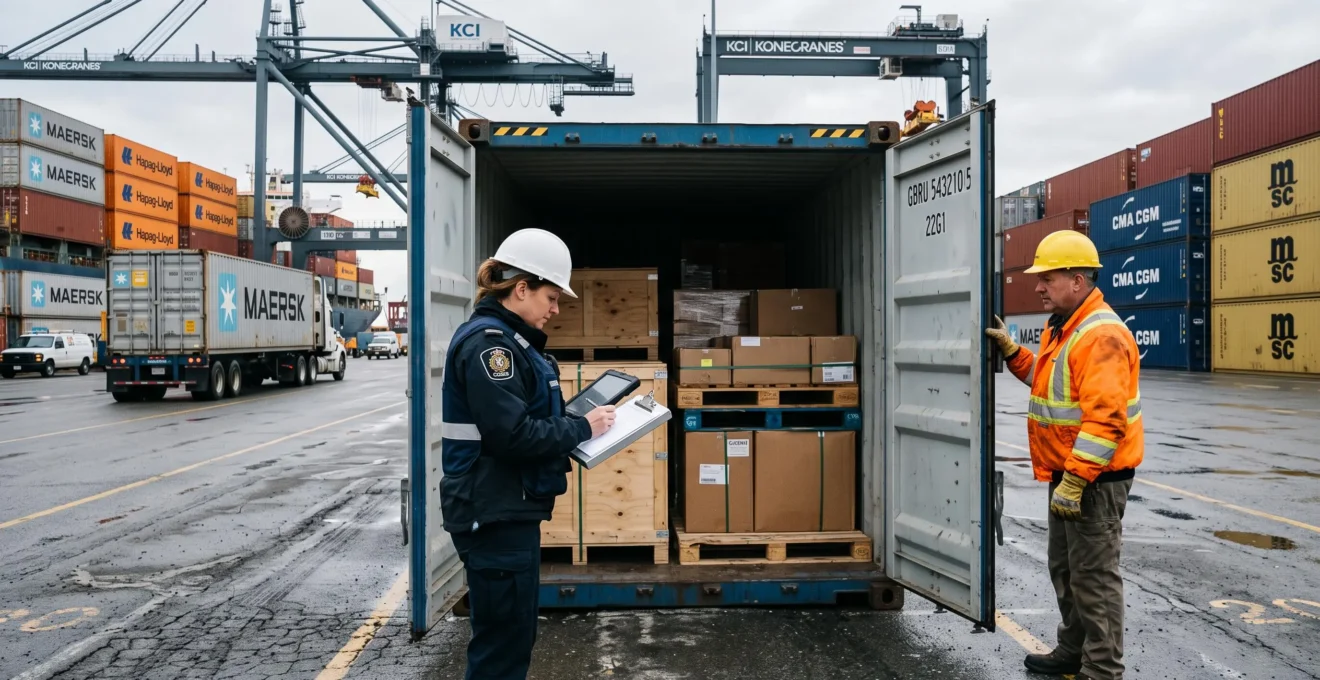
Customs clearance for UK–Canada trade begins before the goods reach the border. The exporter prepares accurate commercial and origin documentation, while the Canadian importer or its authorised customs broker arranges the required import information, release request and accounting procedures. The Canada Border Services Agency (CBSA) assesses whether the goods can be released and whether further examination or regulatory approval is necessary.
Release is not simply a matter of paying customs duty. Goods must be correctly classified, valued and declared, with the necessary permits and evidence of origin available. A shipment can be subject to additional checks even when the commercial invoice is complete and the goods appear eligible for preferential tariffs.
For businesses shipping between the United Kingdom and Canada, the practical objective is to make every required decision before dispatch: who is responsible for importing, which tariff treatment applies, how the electronic release request will be submitted and what must happen after release. These decisions determine whether goods can move promptly or remain at the border awaiting information, examination or payment.
UK–Canada customs clearance at a glance
- Confirm the Canadian importer of record, tariff classification, customs value, origin evidence and commodity-specific requirements before dispatch.
- Arrange the appropriate CBSA release process and coordinate pre-arrival cargo information with the carrier or freight forwarder.
- Distinguish customs release from accounting and payment: goods may be released before duties are paid only when the applicable requirements are met.
- Why Can Two Similar Shipments Face Different Customs Clearance Processes?
- How Can Businesses Prepare for Customs Clearance Before a Shipment Arrives?
- Self-Clearance or Customs Broker: Which Approach Fits Your Business?
- Customs Clearance Errors That Can Keep Goods Stuck at the Border
- When Should Customs Clearance Preparation Start for an International Shipment?
- How Can Businesses Prepare Customs Declaration Data Before Submission?
- CBSA Compliance Errors That Can Delay Commercial Goods Entering Canada
- How Does the CBSA Process Commercial Goods Entering Canada?
Why Can Two Similar Shipments Face Different Customs Clearance Processes?
Two apparently identical UK–Canada shipments can follow different clearance paths because CBSA treatment depends on more than their physical appearance. Tariff classification, declared origin, customs value, importer arrangements, regulatory controls and documentation completeness all influence the procedure. One shipment may qualify for release after electronic review, while another requires additional information or physical examination.
Consider two hypothetical consignments of automotive components arriving in Canada. Both have similar packaging, quantities and commercial values. The first contains standard replacement parts with complete documentation. The second includes components subject to additional technical or regulatory requirements. Their outward similarity does not establish identical admissibility requirements.
Several variables should be assessed independently:
- Tariff classification: the Canadian ten-digit classification determines the applicable tariff provisions and may identify additional requirements.
- Purpose and status: commercial imports and personal goods can fall under different reporting and release arrangements.
- Importer arrangements: the importer must have the necessary registration and a suitable release and payment process.
- Origin: goods dispatched from the UK are not necessarily UK-originating goods.
- Commodity controls: food, health products, aviation goods and certain automotive products may require separate regulatory checks.
For UK-originating products, the UK–Canada Trade Continuity Agreement (TCA) may provide preferential duty rates where the product-specific origin rules and documentary requirements are satisfied. The UK government guidance on trade with Canada explains the relevant origin declaration requirements. Preferential duty is not automatically zero for every product, and an origin statement alone cannot make otherwise ineligible goods qualify.
From 1 September 2026, the Comprehensive and Progressive Agreement for Trans-Pacific Partnership (CPTPP) has also provided an available preferential framework for qualifying UK–Canada trade. The applicable agreement must be assessed separately. CUSMA, which concerns trade among Canada, the United States and Mexico, should not be assumed to apply simply because goods transit a North American port.
A complete pre-arrival release request can be processed without physical inspection, but an examination can still be directed by CBSA. Release on Minimum Documentation (RMD) is not a general fast-track option: its paper-based use is restricted to circumstances qualifying for an exception to mandatory electronic filing.
Five checks to predict your shipment’s clearance path
- Confirm the Canadian ten-digit tariff classification and save the tariff reference for the actual product.
- Identify the importer of record and record its Canadian import account details.
- Verify the claimed preferential tariff treatment against origin documentation and retain the supporting evidence.
- Check commodity-specific permits, licences and certificates, producing a written requirements register.
- Agree on the release method with the broker or carrier and document the responsible party and transaction reference.
The most reliable prediction is therefore based on the declared characteristics and supporting documents of each consignment, not on how quickly a previous shipment of similar goods crossed the border.
How Can Businesses Prepare for Customs Clearance Before a Shipment Arrives?
Businesses should prepare UK–Canada customs clearance by establishing the Canadian import account, confirming tariff classification and origin, identifying required permits and agreeing on an electronic release process before dispatch. The UK exporter must supply accurate shipment documentation, while the Canadian importer must ensure that the appropriate information reaches CBSA. Responsibility must be explicitly allocated.
The Canadian importer generally needs a Business Number (BN) and an import-export program account administered through the CBSA’s commercial registration arrangements. The importer should also establish access to the CARM Client Portal and confirm who will submit commercial accounting information and arrange payment or financial security.
Before goods are collected, the exporter should prepare an invoice identifying the parties, detailed goods descriptions, quantities, values, currency and countries of origin. The shipping documents should consistently identify the shipment and its transport arrangements. Where preferential treatment is claimed, the UK exporter must provide the applicable origin declaration on a qualifying commercial document.
Carrier reporting is a separate responsibility. Electronic advance commercial information, including applicable eManifest requirements, must be transmitted according to the transport mode and relevant CBSA deadlines. Truck, rail, marine and air movements do not share one universal reporting timetable.
The importer or broker may submit release information through the Pre-Arrival Review System (PARS) or the Integrated Import Declaration (IID) process, as applicable. The release request must be connected correctly to the cargo reporting information, including the relevant cargo control number.
CBSA’s Memorandum D17-1-4 on the release of commercial goods provides the operational framework for these procedures, including electronic submission and supporting documentation requirements.
One important distinction concerns release documentation versus accounting. The historical B3 Canada Customs Coding Form remains relevant when reviewing older records, but commercial accounting has moved to the CARM framework and Commercial Accounting Declaration (CAD). Preparing a B3 as the routine current electronic accounting submission would therefore be misleading.
A practical pre-booking verification can be organised into three decisions:
- Check the ten-digit HS classification against the current Canadian Customs Tariff.
- Determine the applicable tariff treatment and verify the supporting origin evidence.
- Identify every commodity-specific regulatory requirement before the carrier receives the goods.
These checks may be straightforward for familiar products, but complex classifications or permit requirements can take substantially longer. They should not be treated as a guaranteed one-hour exercise.
The parties should also settle Incoterms and contractual responsibilities. An Incoterm allocates commercial obligations, but it does not automatically establish that the named party is properly registered or authorised to act as the Canadian importer of record.
Once those responsibilities are documented, businesses can decide whether they have the internal capability to manage release themselves or need specialist representation.
Self-Clearance or Customs Broker: Which Approach Fits Your Business?
Self-clearance is generally more suitable for importers handling relatively simple goods who can manage CBSA registration, tariff classification, release procedures, accounting and payments themselves. A licensed customs broker becomes more valuable when shipments are frequent, regulated or commercially sensitive. The appropriate choice depends on internal expertise, filing capability and the consequences of customs errors.
Self-clearance does not mean bypassing CBSA requirements. The importer must still establish the necessary commercial account, prepare accurate declarations, meet electronic filing obligations or qualify for applicable exceptions, and respond to customs requests. The business must also arrange an acceptable release and payment process.
A broker can classify goods, prepare and submit release requests, handle commercial accounting declarations, advise on tariff treatment, coordinate supporting permits and communicate with CBSA. These services reduce the administrative burden but should be assessed against the actual level of complexity.
The main operational differences are:
| Decision factor | Self-clearance | Customs broker |
|---|---|---|
| Shipment frequency | Can suit occasional, straightforward imports | Useful for recurring or high-volume shipments |
| Tariff classification | Handled by internal staff | Prepared or reviewed by a specialist |
| Electronic filing | Requires suitable systems, access and procedures | Managed through the broker’s authorised filing arrangements |
| Regulated products | Requires in-house commodity knowledge | Can simplify coordination of additional documentation |
| Direct service costs | Avoids brokerage fees but requires staff time and systems | Involves service fees and potentially additional charges |
| Legal accountability | Importer retains responsibility | Importer remains responsible for declaration accuracy |
Freight forwarders may also provide integrated customs services, either directly where appropriately licensed or through a partner broker. This can simplify communication if transport references, invoices and clearance documentation are managed together.
However, a single commercial contact does not necessarily mean a single legal or operational responsibility. Before booking, establish who is transmitting carrier data, who submits release requests, who handles accounting, and who responds if CBSA places the goods on hold.
The financial comparison should include more than brokerage fees. Internal classification mistakes may lead to additional duties, corrections, administrative penalties or avoidable storage costs. Conversely, a business with stable product classifications and capable staff may find direct management proportionate to its requirements.
Using a broker does not transfer the importer’s legal accountability. The importer should review the declaration data, retain supporting documents and maintain oversight of classifications and origin claims.
Whichever approach is selected, the underlying documentation must remain accurate. Most avoidable clearance problems begin with inconsistencies that could have been identified before submission.
Customs Clearance Errors That Can Keep Goods Stuck at the Border
Customs clearance errors can delay UK–Canada shipments when CBSA cannot verify the declared goods, their value, origin or admissibility. Common problems include incomplete invoices, incorrect tariff classifications, mismatched shipment references, unsupported preferential tariff claims and missing regulatory permits. The result may be a request for additional information, a release hold or a physical examination.
An incomplete invoice is particularly disruptive because it supports several decisions at once. If the declared currency is unclear, the customs value may be difficult to determine. If the product description is generic, the tariff classification may be impossible to validate. If origin information is inconsistent, preferential treatment may need to be reconsidered.
Incoterms should also be documented clearly to establish the commercial arrangements and help assess relevant valuation information. Their absence does not automatically create a customs hold, but it can contribute to uncertainty where transport and other charges affect the customs value.
The consequences depend on the type of issue:
- Information query: CBSA or the processing party requests clarification or supporting evidence before a decision can be completed.
- Release hold: the shipment cannot proceed until the outstanding condition is resolved.
- Examination: officers inspect the goods or documents to verify compliance, potentially involving unpacking, handling and additional time.
- Accounting correction: an error discovered after release may require an amended declaration and additional payment.
Not every request for clarification leads to physical inspection, and a pending review should not be confused with permission to deliver goods. The importer must confirm the actual CBSA release status before arranging onward movement.
For regulated goods, a correct tariff and invoice may still be insufficient. Food products can require Canadian Food Inspection Agency-related documentation, while other commodities may be subject to their own federal controls.
Delays can also create costs outside the customs declaration itself. Depending on the terminal, carrier and commercial agreement, businesses may incur storage, demurrage, additional handling charges, missed delivery windows or customer-related costs. No fixed amount can be assumed for these consequences.
A useful internal audit is to compare the most recent three import transactions. Review the original invoice, release documentation, CAD or historical B3 records, origin evidence, subsequent adjustments and applicable CBSA statements. Record whether the same classification or valuation issue appears repeatedly.
This small sample cannot establish an overall compliance rate, but it can reveal patterns worth investigating before further shipments are dispatched.
Preventing documentation mismatches is easier when the checks are incorporated into the shipping schedule rather than performed only after goods have reached Canada.
When Should Customs Clearance Preparation Start for an International Shipment?
Customs clearance preparation should begin before the shipment is booked, particularly for a first-time importer or regulated product. The correct starting point depends on registration, classification, origin evidence, permits and the chosen transport mode. Pre-arrival filing windows do not guarantee immediate clearance, so businesses should schedule backwards from the expected arrival date and carrier cut-offs.
The earliest tasks are often independent of the physical shipment. Establishing a Canadian import account, clarifying importer responsibility and obtaining a classification decision can all be necessary before the commercial documents are finalised.
Origin evidence also deserves early attention. A UK exporter may need to examine the product’s bill of materials, production history or supplier information before supporting a claim under the applicable trade agreement. Dispatch from the UK, on its own, is not evidence of qualifying origin.
Once the goods and trade arrangements are confirmed, businesses can establish the transport schedule and relevant filing deadlines.
45 days / 90 days
Under the CBSA release framework, PARS submissions can be made up to 45 calendar days before arrival, while IID submissions can be made up to 90 days before arrival. These are permissible submission windows, not guaranteed processing times or required advance-notice periods.
CBSA Memorandum D17-1-4, release of commercial goods.
Carrier advance reporting requirements must be checked separately because the timing and responsible carrier arrangements vary by mode. The relevant air, marine, rail or highway reporting deadline cannot be determined merely from the PARS or IID submission window.
A backward-planning process can be organised around four milestones:
- Before booking: establish the importer, tariff classification, potential origin claim and regulatory requirements.
- Before dispatch: finalise commercial documents, verify certificates and permits, and allocate filing responsibilities.
- Before arrival: confirm the carrier’s advance reporting, applicable release submission and matching shipment references.
- At arrival: monitor the release decision and coordinate any examination, supplementary documentation or payment requirement.
For example, a hypothetical importer expecting a container at a Canadian marine terminal should first identify the carrier’s documentation cut-off and any inspection-related requirements. The importer can then work backwards to set internal deadlines for the origin declaration, invoice approval and customs filing.
If preparation begins only when the vessel arrives, the goods may have to remain under customs control while documents or approvals are obtained. Additional storage or handling charges may arise under the applicable commercial arrangements.
Effective scheduling depends on validated data. Preparing a complete declaration dataset before it enters the filing system is therefore the next essential control.
How Can Businesses Prepare Customs Declaration Data Before Submission?
Businesses can prepare Canadian customs declaration data by validating the commercial invoice, ten-digit tariff classification, customs value, country of origin, tariff treatment and shipment identifiers before electronic submission. Preparation is an internal accuracy check; submission is the formal transmission of the required release or accounting information. Both correctness and timing matter for preventing delays.
A customs dataset should identify the seller, buyer, consignee and importer of record, together with the goods’ descriptions, quantities, values, currency, origin and relevant transport details. The declared information must be sufficiently specific to support classification and valuation.
Canada uses a ten-digit tariff classification. The first six digits correspond to the internationally harmonised HS structure, while the additional digits reflect Canadian tariff subdivisions. UK export classifications should not simply be copied into the Canadian declaration without verifying the Canadian tariff number.
The CBSA guidance on Canadian customs duties and tariff treatments explains how classification, origin, customs valuation and tariff treatment affect the applicable charges. Businesses should use the current Canadian Customs Tariff and consider a formal classification ruling when the product is difficult to classify.
The following review pairs essential information with the errors it helps prevent.
| Data field | Validation required | Potential error |
|---|---|---|
| Seller and buyer | Match commercial and transaction records | Inconsistent transaction parties |
| Importer BN and account | Confirm the correct registered importer | Incorrect or missing importer identification |
| Product description | Describe goods precisely and consistently | Insufficient classification information |
| Ten-digit HS classification | Verify against the Canadian Customs Tariff | Wrong duty treatment or regulatory coding |
| Customs value and currency | Reconcile invoice and valuation information | Incorrect duty or tax calculation |
| Country of origin | Confirm manufacturing origin and supporting records | Unsupported origin declaration |
| Preferential tariff claim | Verify eligibility and documentary proof | Invalid preference claim |
| Quantities and weights | Compare invoice, packing list and cargo information | Quantity or shipment mismatch |
| Incoterms and charges | Clarify the contractual terms and valuation components | Incomplete or inconsistent customs valuation |
| Permits and shipment references | Match regulatory documents and cargo identifiers | Release delay or unmatched cargo record |
For historical imports, the B3 Canada Customs Coding Form may form part of the audit trail. For current commercial accounting, businesses must account for the CAD process under CARM. The electronic release request and commercial accounting declaration are related but distinct procedures.
A pre-submission review should compare the data entered into the broker’s system or the business’s customs software against the signed-off commercial records. After submission, acknowledgement of receipt should not be mistaken for confirmation that CBSA has released the goods.
Errors identified before filing can normally be addressed within the internal validation process. Errors identified after submission may require changes through the applicable CBSA process, and late submissions may disrupt clearance even where every data field is accurate.
When classification remains uncertain, the importer can seek expert advice or an appropriate CBSA ruling rather than repeatedly using an unverified code.
Validated declarations also create a stronger documentary record for future compliance reviews, which remain relevant long after the shipment has been delivered.
CBSA Compliance Errors That Can Delay Commercial Goods Entering Canada
CBSA compliance problems arise when commercial imports are inaccurately classified, valued, declared or documented, or when applicable regulatory obligations are not met. Some errors lead to immediate release delays, while others are identified after delivery and require accounting corrections, additional duties or administrative penalties. Importers should distinguish a temporary clearance issue from a continuing compliance obligation.
A shipment held for additional documentation is not necessarily the subject of a penalty. CBSA may need further evidence to assess the tariff classification, country of origin, value for duty or admissibility. The importer can often progress the review by providing accurate records and resolving inconsistencies.
More serious issues can have consequences beyond the immediate shipment. Unsupported preferential origin claims may result in additional duties. Incorrect declared values can require revised accounting. Failure to comply with specified requirements can lead to monetary penalties under the Administrative Monetary Penalty System (AMPS).
CBSA’s guidance on commercial import compliance explains importer obligations concerning classification, valuation, origin, corrections, penalties and records.
For example, suppose a hypothetical importer uses an incorrect tariff classification across several consignments. If the error is discovered after release, the importer may have to correct affected declarations and account for additional duties where required. The relevant correction period and any applicable consequences depend on the facts and customs rules.
Repeated problems may attract further compliance scrutiny, but there is no basis for assuming that every repeated mistake automatically triggers a particular inspection probability or a fixed numerical compliance rating.
A practical compliance record should contain:
- The classification used for each product, including the reasoning and supporting technical information.
- The claimed country of origin, applicable trade agreement and supporting origin evidence.
- The customs value calculation and relevant commercial records.
- Permits, certificates and other documentation required for regulated goods.
- Release decisions, accounting declarations, corrections and CBSA correspondence.
6 years
Commercial importers must retain relevant import documentation for six years following the date of importation, subject to applicable legal requirements. Record retention supports customs verification and subsequent corrections.
CBSA commercial import compliance guidance.
Businesses should maintain a product-level classification register and periodically compare it against actual accounting records. When errors are found, assess correction obligations rather than simply changing the code on future shipments.
Having a broker submit declarations does not eliminate the need for importer oversight. The business should be able to retrieve the evidence behind every material customs decision.
A clear compliance record also helps businesses understand CBSA decisions throughout the actual release and post-release process.
Key takeaways before your goods reach CBSA
- A submitted release request is not confirmation that the goods are authorised to leave customs control.
- Release, commercial accounting and duty payment have distinct requirements and may occur at different stages.
- Keep the shipment’s cargo references, release information and accounting records connected so discrepancies can be resolved promptly.
How Does the CBSA Process Commercial Goods Entering Canada?
CBSA processes commercial goods entering Canada by receiving cargo and release information, assessing the declaration and applicable regulatory requirements, and authorising release when the necessary conditions are satisfied. Goods may be selected for further examination. Commercial accounting and payment are handled through the applicable CBSA arrangements, including CARM, and may occur after release where the importer qualifies.
The process involves several distinct stages, and each has its own operational requirements.
- Advance cargo reporting: the carrier transmits the applicable cargo and conveyance information to CBSA within the required reporting timeframe.
- Release request: the importer or authorised broker submits the appropriate electronic release information and supporting records.
- Arrival and cargo reporting: the shipment must satisfy the applicable reporting and arrival-status requirements before release eligibility.
- CBSA review: the agency evaluates the declaration and any relevant regulatory requirements, including information from participating government departments.
- Examination where required: officers may inspect the goods or request additional evidence before making a release decision.
- Release authorisation: goods may move from customs control when CBSA grants release and any other applicable movement restrictions have been satisfied.
- Commercial accounting and payment: the importer completes accounting and pays applicable duties and taxes under the relevant deadlines and arrangements.
- Record retention and corrections: the importer preserves supporting documentation and addresses errors discovered after release.
CBSA uses electronic release arrangements such as PARS and IID for eligible commercial shipments. Paper RMD is available only in specified circumstances where the mandatory electronic submission requirement does not apply.
Release Prior to Payment (RPP) is an important cash-flow mechanism. An eligible importer that has met the applicable registration and financial security requirements may obtain release before paying the corresponding duties and taxes. Without the required RPP arrangements, payment before release may be necessary.
| Arrangement | Operational effect | Cash-flow implication |
|---|---|---|
| Pre-arrival electronic release through PARS or IID | Release information is submitted for CBSA processing in advance | Does not independently determine when duties must be paid |
| Release Prior to Payment (RPP) | Eligible goods can be released before duties and taxes are paid | Payment follows the applicable accounting and payment requirements |
| Release with payment required beforehand | Goods remain subject to applicable payment conditions before release | Funds must be available before the shipment can be released |
| Paper RMD under an EDI exception | Release documentation is submitted under the permitted paper procedure | Payment timing depends on the importer’s applicable arrangements |
The crucial distinction is that PARS or IID identifies how release information is submitted, whereas RPP addresses the conditions for obtaining release before payment. They are not mutually exclusive alternatives within a single category.
CBSA also applies customs controls alongside requirements administered by other federal authorities. A shipment of food products, for example, may require admissibility checks involving the Canadian Food Inspection Agency. Even where a tariff calculation is straightforward, missing regulatory documentation may prevent release.
Once CBSA authorises release, the importer must still meet the applicable commercial accounting and payment requirements. CARM provides the commercial accounting and revenue management framework, including the relevant statements of account and payment arrangements.
The importer should reconcile CBSA accounting information with its own transaction records and investigate differences in duties, taxes, valuation or tariff treatment. Supporting invoices, origin evidence and customs documents must remain available for subsequent verification.
For businesses managing repeated UK–Canada shipments, the practical measure of a successful clearance process is not merely the absence of a border hold. It is the ability to connect every stage, from origin determination and pre-arrival filing to release, payment and post-import compliance.
For the next UK–Canada consignment, begin by confirming the importer of record, validating the Canadian tariff classification and origin evidence, and assigning responsibility for cargo reporting, electronic release and CARM accounting. Keep the supporting records together and obtain confirmation of the CBSA release decision before arranging delivery.
Does every commercial shipment from the UK to Canada require customs clearance?
Commercial goods entering Canada are subject to applicable customs reporting, admissibility and release requirements. The exact procedure depends on the goods, transport mode, import arrangements and any relevant exceptions. A shipment’s small size or low commercial value does not, by itself, remove all customs obligations.
Can UK-origin goods enter Canada duty-free under a trade agreement?
Qualifying UK-origin goods may benefit from preferential tariffs under the UK–Canada Trade Continuity Agreement or, where applicable, CPTPP. Eligibility depends on the relevant agreement, product-specific origin rules, tariff schedule and documentary requirements. Preferential treatment does not necessarily eliminate GST or other applicable import charges.
Can Canadian customs release goods before import duties are paid?
Yes, where the importer qualifies for Release Prior to Payment and meets the applicable CBSA registration and financial security requirements. Customs accounting and payment must still be completed according to the relevant deadlines. Importers without the necessary arrangements may need to pay before release.
Is CBSA electronic submission confirmation the same as customs release?
No. Confirmation that an electronic submission has been received or accepted for processing does not necessarily authorise the movement of goods. The importer or broker must confirm that the shipment has received the appropriate release status and that any other applicable restrictions have been resolved.
What should an importer do if a customs error is discovered after delivery?
The importer should identify the affected transactions, review the original declarations and evidence, and determine the applicable correction obligations. Errors involving classification, origin or valuation may require amendments and additional duties. Relevant import documentation must generally be retained for six years following importation.