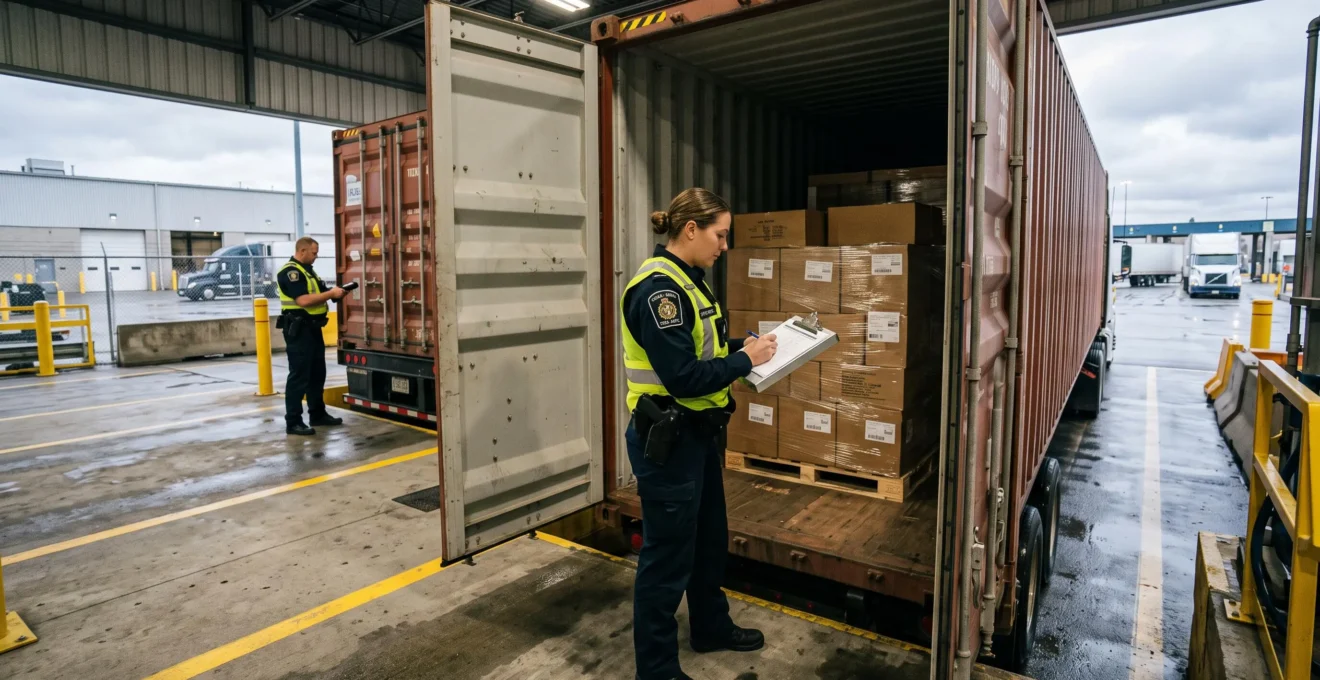
A commercial shipment can have its transport booked, customs duties calculated and paperwork submitted yet still be held at the border. Before releasing goods, border authorities may examine their classification, declared value, origin, documentation, admissibility and compliance with product-specific regulations.
For businesses trading between the United Kingdom and Canada, these checks involve more than a single customs authority. The Canada Border Services Agency (CBSA) administers Canadian border procedures, but goods may also fall under requirements enforced by food, health, environmental or other regulators. UK export controls create a separate set of obligations before departure.
Understanding how these requirements interact helps importers distinguish between a shipment that is ready for transportation and one that is genuinely ready for customs release. The practical objective is not to eliminate inspections, which authorities retain the right to conduct, but to make every relevant declaration accurate, supported and consistent before goods reach the border.
Commercial shipment release: the essentials
- Border agencies verify more than tariffs: product admissibility, origin, declared value, documentation and regulatory compliance can all affect release.
- Early preparation requires correct tariff classification, consistent shipping documents, applicable permits and properly submitted advance information.
- Canadian customs release does not necessarily end an importer’s obligations. The CBSA can verify declarations after importation, and records must be retained.
- Why Do Border Agencies Check Safety, Origin and Documentation as Well as Tariffs?
- How Can Importers Prepare for a Border Agency Review Without Delaying Clearance?
- Customs, Tax or Product Regulator: Which Authority Handles Your Requirement?
- Border Agency Mistakes That Can Turn a Routine Shipment Into a Lengthy Hold
- When Should a Business Contact a Border Agency Before Importing Goods?
- How Can UK Exporters Prepare Goods for CBSA Clearance in Canada?
- The Trade Control Checks That Businesses Often Miss Before Exporting
- How Does the CBSA Process Commercial Goods Entering Canada?
Why Do Border Agencies Check Safety, Origin and Documentation as Well as Tariffs?
Border agencies check safety, origin and documentation because collecting import duties is only one part of their responsibility. They must also determine whether goods can legally enter the country, whether regulatory requirements have been met and whether the information declared accurately describes the shipment. Paying the correct tariff does not automatically make a product admissible.
Canada’s border framework combines customs administration with controls supporting public safety, health, economic protection and compliance with legislation administered by other government departments. The CBSA may inspect commercial goods to confirm that their physical characteristics match the declarations submitted.
Three distinct layers of compliance therefore matter.
- Product compliance: the goods must satisfy applicable safety, health, environmental, marking and other regulatory requirements. Certain products require permits, certificates or additional approvals.
- Origin compliance: the declared country of origin must be supported by evidence, particularly where the importer claims preferential tariff treatment under a trade agreement.
- Documentary compliance: invoices, shipping information, customs declarations and supporting documents must describe the same commercial transaction and goods accurately.
These layers are connected but are not interchangeable. A shipment may qualify for a reduced customs duty rate while failing a product safety requirement. Conversely, an admissible product may attract additional duties if its claimed preferential origin cannot be demonstrated.
For UK–Canada trade, the distinction between preferential origin and the country from which goods are shipped is particularly important. A product dispatched from a British warehouse is not automatically UK-originating under the relevant trade agreement. Its origin depends on the applicable rules and the production history of the goods.
Origin is also a continuing compliance concern. The CBSA can review origin, tariff classification and valuation after release. An unsupported preferential claim may therefore result in an adjustment to duties well after the shipment has reached its destination.
Other Canadian authorities can impose additional requirements. For example, the Canadian Food Inspection Agency (CFIA) regulates relevant food, plant and animal imports. Goods subject to these controls may require documentation or authorisation beyond ordinary customs paperwork.
The CBSA’s guidance on shipping and reporting commercial goods explains that commercial shipments can undergo examinations and checks related to other government departments’ requirements.
Businesses should therefore assess whether goods can legally enter the destination market before concentrating on the amount of duty payable. That assessment provides the foundation for preparing a shipment that can withstand documentary or physical examination.
How Can Importers Prepare for a Border Agency Review Without Delaying Clearance?
Importers can prepare for a border agency review by validating tariff classification, product requirements and supporting documents before dispatch. They should also coordinate advance reporting with the carrier and ensure the Canadian importer or customs broker can submit the necessary release information. Preparation reduces avoidable discrepancies, although it cannot guarantee immediate clearance or prevent an examination.
The starting point is the product, not the shipping document. Determine the appropriate Harmonized System (HS) classification using the goods’ actual characteristics, intended function and composition. That classification helps establish the applicable customs treatment and identify regulatory requirements that warrant further investigation.
Next, verify whether the product requires an import permit, certificate, inspection or other regulatory approval. A customs broker may help identify relevant requirements, but a broker’s involvement does not replace the need for accurate product information from the importer and exporter.
The commercial invoice should provide a consistent account of the transaction, including a sufficiently detailed goods description, quantities, prices, currency and information needed to determine customs value and origin. The relevant delivery term and the parties’ responsibilities should also be clear.
Advance reporting is another essential consideration. Under Canada’s Advance Commercial Information framework, carriers are generally responsible for transmitting required cargo and conveyance information within the prescribed deadlines, subject to applicable exceptions. The precise requirements depend on the transportation mode and reporting arrangements.
CARM, the CBSA Assessment and Revenue Management system, serves a different function. It supports commercial import accounting, assessment and payment processes. Businesses should not confuse a carrier’s advance cargo reporting obligations with an importer’s customs accounting responsibilities.
Before dispatch, compare the main shipment records across the following fields.
| Information | Documents to compare | Potential discrepancy |
|---|---|---|
| Goods description | Invoice, packing list, customs data | Generic or conflicting product descriptions |
| Quantity and weight | Packing list, transport documents, invoice | Different carton counts, quantities or weights |
| Declared value | Invoice, transaction records, customs declaration | Unsupported value or inconsistent currency |
| Origin | Origin evidence, invoice, preference documentation | Origin claim unsupported by production records |
| Regulatory approval | Product specifications, permits, certificates | Missing or inapplicable authorisation |
A small description discrepancy may be resolved with clarification or corrected documentation, depending on its nature and the stage of processing. A material inconsistency affecting valuation, origin or admissibility can require more substantial review. There is no universal rule that makes one category of error automatically harmless.
Five checks to complete before dispatch
- Confirm the product classification and save a classification worksheet with the relevant specifications.
- Check destination-country regulatory requirements and produce a permit-and-certificate register showing what is required and obtained.
- Reconcile the invoice, packing list and transport instructions, retaining an approved document set.
- Verify the parties responsible for cargo reporting, release requests and Canadian customs accounting, recording their names and assigned tasks.
- Review origin evidence and import-payment arrangements, then sign off a shipment-specific clearance readiness record.
Licensed customs brokers provide valuable technical and operational support, particularly where unfamiliar tariff provisions or release procedures are involved. Nevertheless, appointing a broker does not automatically transfer the importer’s legal obligations to that intermediary.
The most reliable preparation combines accurate product data, agreed responsibilities and a traceable documentary record. The next challenge is determining which authority controls each requirement.
Customs, Tax or Product Regulator: Which Authority Handles Your Requirement?
The responsible authority depends on the legal requirement rather than simply on the shipment’s location. In Canada, the CBSA handles border release and customs administration, while other government departments regulate particular products. Tax obligations may involve both border administration and the Canada Revenue Agency. UK export obligations are administered separately by the relevant British authorities.
For a business shipping goods from the United Kingdom to Canada, the distinction is operationally significant. A shipment may satisfy UK export formalities but remain subject to an import permit, safety restriction or product standard in Canada.
The following comparison identifies the principal responsibilities without implying that each authority handles every aspect of a particular product category.
| Authority | Principal responsibility | Typical business question |
|---|---|---|
| Canada Border Services Agency (CBSA) | Import reporting, customs release, customs duties and applicable border enforcement | What is needed for the shipment to be released? |
| Canada Revenue Agency (CRA) | Administration of applicable domestic tax obligations, including relevant GST/HST and excise matters | How must the business account for its tax obligations? |
| Canadian Food Inspection Agency (CFIA) | Regulatory controls for relevant food, plant and animal products | Does the product require a permit, certificate or inspection? |
| Health Canada | Requirements for regulated health and consumer product categories | Does the product satisfy applicable Canadian safety and regulatory rules? |
| HM Revenue & Customs (HMRC) | UK customs procedures and related fiscal administration | Have the export declaration and customs requirements been addressed? |
| UK Border Force | Border enforcement and relevant controls | Is the shipment subject to intervention or enforcement checks? |
| Relevant UK licensing authority | Export licensing or strategic trade controls within its remit | Does the product or transaction require export authorisation? |
Canadian import GST and tax administration require particular care. The CBSA may assess and collect applicable import taxes at the border, while the CRA administers broader GST/HST and other tax obligations. These responsibilities should not be treated as completely separate collection systems.
The product’s HS classification offers a practical starting point for identifying restrictions, but the code alone does not establish every regulatory obligation. Composition, intended use, end user and product presentation may also determine which rules apply.
Consider a hypothetical shipment of packaged food from a UK manufacturer to a Canadian distributor. The parties may need to address UK export declarations, Canadian customs release, food import requirements and product labelling. Satisfying one obligation does not remove the others.
Some products therefore fall under cumulative requirements. An importer may need a customs account, product-specific authorisation and compliant labels, each involving different administrative processes.
Once responsibilities are assigned, businesses can focus on the documentary and procedural errors most likely to interrupt release.
Border Agency Mistakes That Can Turn a Routine Shipment Into a Lengthy Hold
Incorrect values, unsupported origin claims, classification errors and missing regulatory documents can turn an otherwise routine shipment into a customs hold. These discrepancies may prevent officers from confirming that the goods match the declaration or comply with import requirements. The consequences depend on the seriousness of the issue and may range from requests for clarification to examination, reassessment or enforcement action.
One common problem is a mismatch between the commercial invoice and the customs declaration. If the declared value does not correspond with the supporting transaction records, authorities may seek further evidence to establish the appropriate customs value.
Classification errors create a different risk. An incorrect tariff classification can affect duty calculations and the treatment of particular goods. Importers may subsequently need to correct the declaration and address resulting duty differences.
Missing product approvals can be more difficult to resolve. Where goods cannot lawfully enter without a specified certificate, permit or other condition, an invoice correction alone will not establish admissibility.
Border authorities also use risk assessment and targeting to determine which shipments require attention. Document discrepancies and compliance information may be relevant to those decisions, but there is no substantiated universal probability that a particular error will result in a full physical examination.
When customs officials hold a shipment, the appropriate response depends on the stated reason. A request for supplementary evidence should be answered with records relevant to the disputed information. Businesses should not assume that replacing a document without explaining the underlying discrepancy will necessarily resolve the problem.
Possible outcomes differ considerably. A valuation or classification issue may result in adjusted duties and other applicable consequences. Goods that are inadmissible under relevant legislation may face refusal, seizure, return or destruction, depending on the circumstances and legal authority involved.
Not every hold is a formal customs decision that can immediately be appealed. The importer should identify whether the issue concerns an examination, a documentary request, a regulatory refusal or an appealable determination.
For applicable Canadian determinations involving origin, tariff classification or customs value, statutory review mechanisms exist. The CBSA identifies a 90-day period for requesting an impartial review of most qualifying initial determinations.
A shipment-specific record should preserve communications, supporting documents, decisions and relevant dates. This is particularly important when a disagreement continues beyond the initial release process.
Businesses facing recurring uncertainty should consider whether the issue could have been resolved through regulatory clarification before the goods were shipped.
When Should a Business Contact a Border Agency Before Importing Goods?
A business should contact the relevant border authority before importing when a material compliance question cannot be resolved reliably through published requirements or qualified professional review. Examples include uncertain tariff classification, unfamiliar regulated products, complex origin questions or a potential need for an advance ruling. Routine shipments with well-established requirements generally do not need individual pre-approval from customs.
Early contact is most useful when the answer could change a purchasing, manufacturing, documentation or shipping decision. Once goods are in transit, some compliance problems become more difficult to correct.
For example, a Canadian importer purchasing a technically complex machine may need clarification about its tariff classification. A formal advance ruling, where the circumstances qualify, can provide greater certainty about the treatment of the described goods than an informal conversation.
The scope of an advance ruling matters. A tariff classification ruling does not automatically certify product safety, establish preferential origin or guarantee that the shipment will be released without examination.
Businesses should distinguish between three forms of engagement:
- General enquiries: useful for understanding published requirements and identifying the appropriate authority, but not necessarily binding for a particular shipment.
- Formal rulings: available for specified matters under applicable procedures and subject to their terms, conditions and disclosed facts.
- Shipment-specific enquiries: appropriate when a consignment is already subject to a documented hold or additional-information request.
A formal ruling should be requested sufficiently early to be useful for the planned transaction. The applicable processing procedure, required information and any published service standard should be checked rather than assuming that a decision will arrive before a particular shipping date.
Where the issue concerns a regulated food, health or other controlled product, the relevant product regulator may be the appropriate first contact. The CBSA’s authority to release goods does not mean it can independently grant every product authorisation.
Any material advice should be documented, including the question asked, the product facts supplied and the response received. An informal answer is not automatically legally binding, but a clear record can help explain the business’s compliance decisions.
Pre-import contact also has limits. Customs officers may still examine goods, verify information or enforce applicable requirements after the importer has received general guidance or a formal ruling.
For exporters supplying the Canadian market, the next priority is ensuring that British export preparations are compatible with Canadian import requirements.
How Can UK Exporters Prepare Goods for CBSA Clearance in Canada?
UK exporters can prepare goods for CBSA clearance by supplying accurate commercial documents, establishing the goods’ origin, checking Canadian product requirements and coordinating with the importer responsible for customs release. They must also identify whether preferential duty treatment is available under the Canada–UK Trade Continuity Agreement and ensure the Canadian importing party has the required accounting and payment arrangements.
The preferential trade framework deserves particular attention. After Brexit, the EU–Canada Comprehensive Economic and Trade Agreement (CETA) ceased to apply directly to the United Kingdom. UK–Canada preferential trade is instead governed by the Canada–UK Trade Continuity Agreement (TCA), which incorporates substantial CETA provisions subject to adaptations.
The official Canada–UK Trade Continuity Agreement establishes the bilateral framework relevant to preferential treatment.
Preferential tariffs are conditional. Goods must meet the applicable rules of origin, and the importer must have the documentation necessary to support the claim. A British business address, UK shipping origin or invoice issued in sterling is not sufficient evidence by itself.
The exporter should establish whether the product satisfies the applicable origin rule and prepare the required origin declaration or other supporting evidence in accordance with the agreement’s relevant provisions. The specific wording and documentary conditions should be checked for the transaction rather than replaced with an informal origin statement.
Beyond origin, the Canadian import file ordinarily needs a suitable commercial invoice, transport information and supporting regulatory documents where applicable. The carrier’s eManifest obligations must be coordinated separately from the importer’s release and accounting arrangements.
Delivery terms also influence operational responsibilities. Under an agreed Incoterm, the seller and buyer allocate specified costs, risks and clearance obligations. However, the Incoterm does not independently determine every customs, tax or regulatory responsibility under Canadian law.
For example, a UK seller agreeing to deliver under Delivered Duty Paid (DDP) terms generally undertakes import clearance obligations under that commercial arrangement. The parties must still establish how those obligations will legally and practically be fulfilled in Canada, including who can act as importer and how duties and taxes will be handled.
A seller arranging international transport under another delivery term may not be the Canadian importer of record. Nevertheless, incorrect invoices or unsupported origin claims supplied by the exporter can still obstruct the importer’s clearance process.
CARM adds another operational dependency. The Canadian importer must understand the applicable registration, accounting and payment requirements. Where release before payment is intended, the relevant programme participation and financial security conditions must also be satisfied.
A UK exporter should therefore confirm the Canadian importing entity, customs broker arrangements where used, responsibility for release documentation, any origin claim and the agreed treatment of import charges before dispatch.
Once that coordination is established, the parties should also examine trade controls that exist outside ordinary tariff and clearance procedures.
The Trade Control Checks That Businesses Often Miss Before Exporting
Businesses preparing exports often overlook controls that are separate from tariff classification and customs declarations. These include sanctions, strategic export licensing, end-use restrictions, product safety rules, labelling obligations and origin marking. A shipment may satisfy routine customs requirements but still be prohibited, restricted or non-compliant because of its product characteristics, destination or intended recipient.
UK exporters should assess whether the goods fall within strategic export controls, including relevant military or dual-use classifications. Depending on the product and transaction, an export licence may be required before goods leave the United Kingdom.
Sanctions screening is a separate exercise. The business should examine relevant counterparties, destinations, ownership information and transaction restrictions rather than checking only the immediate buyer’s trading name.
End-use information may matter even when goods appear commercially ordinary. Equipment, software or components with potential controlled applications can require further assessment based on their specifications, intended use and applicable law.
On the Canadian side, product safety and labelling obligations deserve independent attention. Bilingual English–French labelling requirements apply to specified information on many consumer products under relevant Canadian legislation, but the exact rules and exemptions depend on the product category.
These requirements should not be attributed generally to Canada’s Official Languages Act. Consumer packaging, food labelling and other sector-specific legislation provide the relevant requirements for many commercial goods.
Country-of-origin marking is another distinct issue. Customs origin declarations, preferential origin claims and physical product-marking requirements may operate under different rules. Businesses should verify which marking obligations apply rather than assuming that placing a country name on a carton resolves all origin requirements.
Used, refurbished and multi-component goods present particular documentation challenges. Their production history and component sourcing may complicate origin determination, while product condition can influence whether applicable safety or other regulatory requirements have been met.
Hypothetical example: refurbished industrial equipment
A UK business plans to ship a refurbished industrial control unit containing components sourced from several countries to a Canadian buyer.
Before dispatch, the business needs to establish its correct tariff classification, assess applicable UK strategic export controls, determine whether any preferential origin claim is supportable and confirm relevant Canadian import requirements. The fact that the refurbishment took place in the UK does not, by itself, establish preferential UK origin.
The example illustrates why export controls, product admissibility and preferential origin should be assessed separately. A problem with one requirement cannot necessarily be cured by providing evidence that another requirement has been satisfied.
After these checks are complete, the shipment can proceed through the applicable Canadian reporting, release and accounting stages. Understanding those stages clarifies when goods are legally available to the importer and which obligations continue afterwards.
Key takeaways before Canadian customs processing
- Confirm which party is responsible for Canadian import release and whether its customs accounting and payment arrangements are in place.
- Distinguish carrier advance reporting from importer release documentation and subsequent duty-and-tax accounting.
- Preserve supporting records after delivery because customs release does not prevent later verification or adjustment.
How Does the CBSA Process Commercial Goods Entering Canada?
The CBSA processes commercial imports through reporting, risk assessment, release and customs accounting procedures. Carriers provide required advance cargo information, while the importer or authorised representative submits the appropriate release and accounting information. The agency may examine or hold goods before release. Once release is authorised, subsequent accounting, payment and verification obligations can still apply.
The process is best understood as a sequence of related but distinct administrative stages. The exact requirements depend on the transport mode, applicable programmes and the circumstances of the importation.
- Advance reporting: the carrier submits the required cargo and conveyance information within the applicable time limits, unless an exemption or alternative reporting rule applies.
- Import documentation: the importer or authorised representative prepares the information needed for customs release, including details of the goods, value, classification and applicable regulatory requirements.
- Risk assessment and examination: the CBSA assesses the shipment and may require documentary verification or physical examination. Other government departments’ requirements can also affect admissibility.
- Release decision: goods are released when the applicable conditions have been met and the CBSA authorises their removal for use in Canada.
- Accounting and payment: commercial import information is accounted for through the applicable process, with duties and taxes assessed and paid according to the importer’s arrangements.
- Post-import verification: declarations and supporting records may be reviewed after the shipment has been released.
Advance submission of information can support processing before goods arrive, but it does not ensure that customs release will be granted before arrival. Examination requirements or unresolved regulatory conditions can still affect the timing.
There is also a crucial distinction between physical release and the payment of import charges. The CBSA’s guidance on releasing, accounting for and paying duties and taxes explains how Canadian importers can use the Release Prior to Payment (RPP) programme when its conditions are met.
| Criterion | Release Prior to Payment | Release with payment |
|---|---|---|
| Eligibility | Requires participation in the applicable RPP programme and satisfaction of its conditions | Available through the applicable payment-at-release arrangements |
| Financial security | Required under the RPP framework | RPP financial security is not the basis of release |
| Payment timing | Payment follows release according to the applicable accounting and payment rules | Applicable duties and taxes are paid at release |
| Operational implication | Can separate the physical movement of goods from the payment date | Payment must be arranged before goods can be released |
The RPP arrangement can offer working-capital and administrative benefits to eligible importers. It should not, however, be interpreted as an exemption from examination, documentation requirements or the eventual payment of duties and taxes.
CARM supports the CBSA’s commercial accounting and revenue management processes. Importers need accurate classification, origin and valuation information for customs accounting, regardless of whether the underlying documents were prepared internally or through a licensed broker.
Customs compliance continues after release. The CBSA can verify and adjust origin, customs valuation and tariff classification information for up to four years after importation in the circumstances described by its commercial import procedures.
6 years
The period for which importers must generally retain prescribed records relating to imported goods. This recordkeeping period is distinct from the CBSA’s commonly applicable four-year verification period.
Canada Border Services Agency — commercial import recordkeeping and post-accounting guidance.
Importers also have correction obligations. Where the conditions under section 32.2 of Canada’s Customs Act are met, errors involving origin, tariff classification or value for duty generally require correction within 90 days after the importer has reason to believe the declaration was incorrect.
Not every post-import change follows the same procedure or deadline. Businesses should distinguish mandatory corrections, requests for adjustments and formal reviews of CBSA decisions.
The CBSA’s rules on post-importation corrections and verifications explain the relevant correction procedures, time limits and administrative review mechanisms.
For a UK supplier and Canadian importer, these obligations make documentary traceability essential. Purchase records, technical specifications, origin evidence and other supporting information may be needed long after the carrier has delivered the goods.
Before arranging the next UK–Canada commercial shipment, confirm the importer of record, validate classification and origin, complete product-specific checks and establish how the required documents will be retained. These practical steps support clearance readiness without assuming that any shipment is exempt from border examination.
Does paying customs duty guarantee that commercial goods will be released?
No. Payment of applicable duties and taxes does not override product restrictions, documentary requirements or other conditions of admissibility. The CBSA may require examination or confirmation that relevant government regulations have been satisfied before authorising release.
Can a shipment be released without a physical customs inspection?
Yes. Commercial shipments do not necessarily undergo a physical examination. The CBSA uses reporting information and assessment procedures to determine whether further verification is required. A shipment that is not physically examined must nevertheless comply with the applicable legal requirements.
Does a Canadian importer always need to pay duties before receiving the goods?
No. Eligible importers participating in the CBSA’s Release Prior to Payment programme can obtain release before paying applicable duties and taxes, subject to registration, financial security and programme conditions. Importers without the required arrangements must follow the applicable payment-at-release procedure.
Can customs authorities reassess a shipment after it has been delivered?
Yes. The CBSA may verify and adjust commercial import information concerning origin, tariff classification and customs value after release. Its published procedures describe a commonly applicable verification period of up to four years, while prescribed import records generally need to be retained for six years.
Can a UK exporter claim preferential Canadian tariffs simply because goods were shipped from Britain?
No. Preferential treatment under the Canada–UK Trade Continuity Agreement depends on compliance with the applicable rules of origin and supporting documentary requirements. Shipping goods from the UK does not itself establish UK preferential origin. The importer must be able to support any preferential tariff claim.